一句话论断
我们赌:用变 W1 椭圆环 × 物理掩模 × 方位角的三层空间分解(epa-hierarchy),把 M31 盘上 0.2 keV 和 0.7 keV 两层辐射分别拆成恒星本底、SF 反馈气体、弥散热晕/前景三个正交可测的成分,能把"这两团气体到底各是什么"从定性猜测变成两条形状不同、可分别检验的径向曲线。
M31HotISM · research draft
我们赌:用变 W1 椭圆环 × 物理掩模 × 方位角的三层空间分解(epa-hierarchy),把 M31 盘上 0.2 keV 和 0.7 keV 两层辐射分别拆成恒星本底、SF 反馈气体、弥散热晕/前景三个正交可测的成分,能把"这两团气体到底各是什么"从定性猜测变成两条形状不同、可分别检验的径向曲线。
SrcApec+MWhalo 剖面已出(8arcmin-profile-regions, srcapec-9pt-profile, mwhalo-9pt-profile),但 a=92′ 一环经 PI 复核认定不可信已排除(theo-exp-a092-excluded-unreliable),a=56–64′ 环一度因拟合质量被排除、后经重新拟合确认问题真实存在但不算离群,2026-09-11 起以标注 rstat 偏高的方式重新纳入(theo-exp-a056-064-included-flagged),理论预期分析下述全部基于剩下 9 个环;理论预期分析已扣除 M31CGM 独立测出的 MWhalo 本底——2026-09-10 一次由 PI 质疑触发的 adversarial review 发现上一版残差显著性算错了(用错了本底不确定度),改正后 9 个环的残差全部与本底一致,没有统计显著的超出或亏缺(mwhalo-baseline-m31cgm, mwhalo-residual-consistent-with-baseline);同一次复核还发现一处口径问题——盘上拟合固定前景吸收 nH=0.03,晕场各自用 HI4PI 实测值(均值 0.0585),二者不匹配,已做保守修正但仍是下限(mwhalo-nh-mismatch-caveat)。conf() 跑满 10 小时 CPU 上限被终止,不是"还没出",是"算不出来",e033-joint-branchC);Mineo 关系也没有给出其 0.71 keV 热相的单独归一化,外区 0.7 keV 超出恒星预言的部分是否是这一热相,暂时无法用文献数字检验。两个温度层现在讲的是两个不同的故事:0.7 keV 大致追踪恒星质量、但线性/幂律拟合都不够好、观测/预言之比还随半径持续上升,不能简单读成"基本就是老年星族";0.2 keV 必须先扣掉 M31CGM 独立测出的前景+CGM 本底才能谈本地起源——正确传播本底的场间散布之后,9 个可信环(已排除 a=92′,含重新纳入的 a=56–64′)的残差目前处处与本底一致,没有统计显著的超出或亏缺(上一版曾用错误的误差算出"内区超出、外区亏缺",已被 2026-09-10 一次由 PI 质疑触发的 adversarial review 找出并订正)。同一次复核还留下一个未解决的口径问题:盘上拟合固定前景吸收 nH=0.03,独立测出本底的晕场各自用的是 HI4PI 实测值(更高),这个不匹配理论上会让盘上的本征值系统性偏低。如果〈理论预期〉这套区分最终成立,M31HotISM 就把"0.6–0.8 keV 弥散辐射"这一个笼统问题拆成了两个可以分别回答的问题。答错的代价:把恒星本底的系统误差误判为晕气体探测,或反过来把真实的晕信号错当成前景扣掉;不扣本底直接拿 0.2 keV 去比恒星/SFR,或者把统计显著性算错,都会得到一个看似干净、实则无效的结论——这正是本 draft 已经犯过两次、又改正过两次的错误类型。
MWhalo 是 MW 前景+M31 CGM+可能的盘内成分三者混合,不能直接拿去回归 Σ_*;改用 M31CGM 独立测出的纯晕场本底做扣除,只解读残差,第二版的斜率/Mineo 对比结论撤回,见〈理论预期〉。同批加了 kT(a) 温度剖面图和 Σ_*/Σ_SFR 形状参考曲线。SrcApec+MWhalo 剖面完成并公开发布(srcapec-9pt-profile)。你熟悉 X 光谱统计、APEC/XSPEC 拟合、多温分解的一般方法论;本节只标出这个项目特有的 gap,不解释软质子、APEC 模型这类通用背景。
M31HotISM 起源于 M31Center 项目一次 RGS 探测的追问(m31center-rgs-detection,M31Center 是独立项目,此处仅作起源提及,不在本 draft 展开讨论)。那次单点谱拟合无法排除 O-norm 简并的解释(07kev-physical-reality),E×P×A 空间分解框架(epa-hierarchy)正是为此而提出:不再依赖单点谱拟合的简并判断,而是用"这个成分是否随 M*/Σ_SFR/R_proj 变化"这一空间判据去交叉验证。这是本 draft 后续所有理论预期讨论的出发点:我们不是在问"0.7 keV 拟合得好不好",而是在问"0.7 keV 的径向轮廓像哪一种已知物理"。
生产提取只用了 E 层:变 W1 等照度椭圆环(variable-w1-geometry),MOS-only(PN 因边角统计/OOT 污染暂弃用),no_background 拓扑联合拟合每个环的全部 ObsID 谱。P(物理掩模:核球/旋臂/环带/臂间)与 A(方位角细分)两层设计已完成但尚未用于当前提取——这是把"空间判据"落地为"方位角/物理块对比"的下一步,见〈下一步〉。
每个环:LB(本星系群前景,kT=0.1 固定)+ MWhalo(kT 自由 0.10–0.35, Z=0.3,银河系晕+可能的 M31 内晕叠加)+ CXB 幂律(Γ 固定)+ 仪器线 + soft-proton 连续谱 + SrcApec(kT 自由 0.5–1.0,Z=1 angr,本 draft 讨论的核心成分)——完整模型契约见 srcapec-fit-model-contract。丰度统一 angr;o-abundance-angr-vs-wilm 记录了与 M31Center 原始探测(wilm)的口径差异。
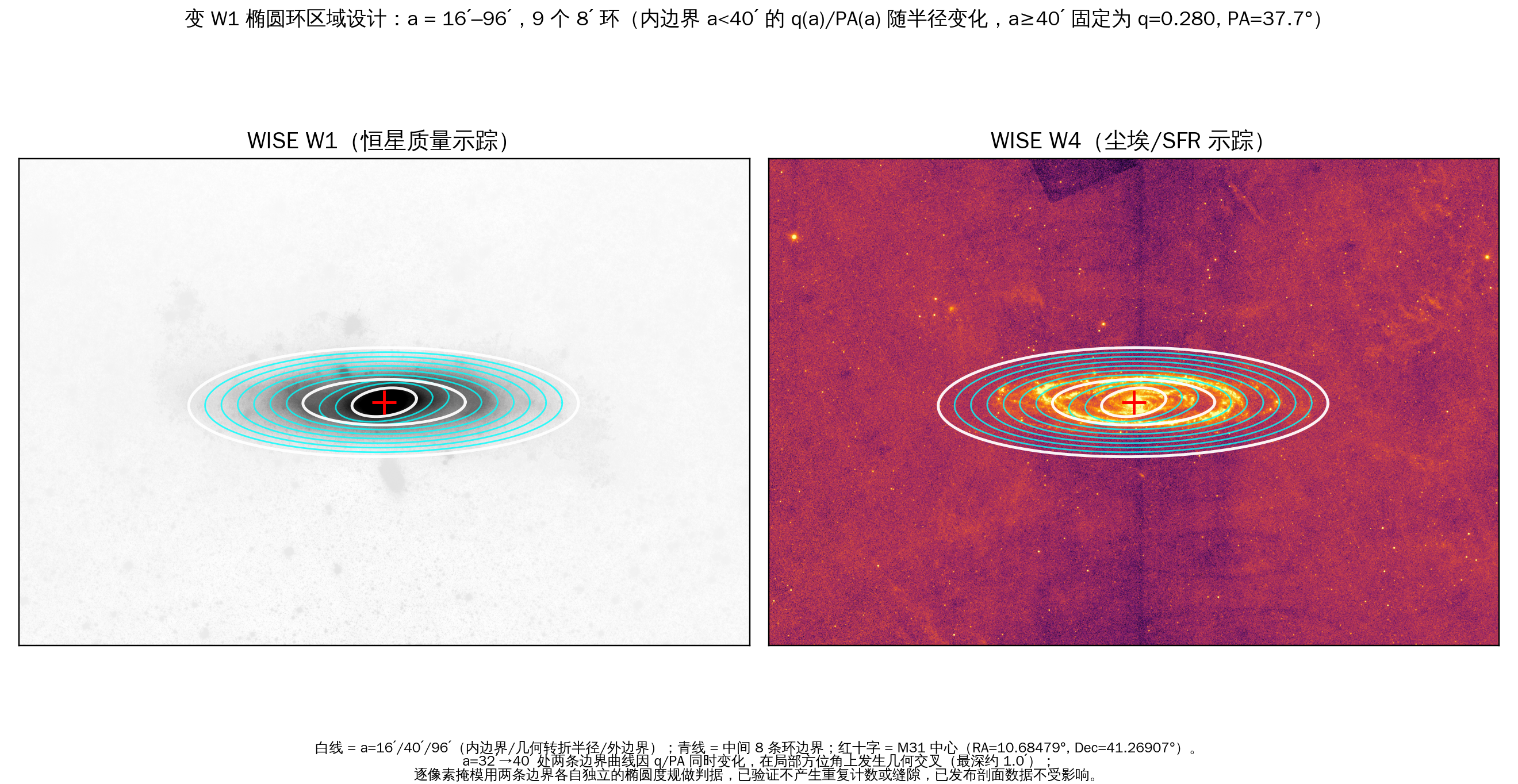
图A:9 个 8′ 环共 11 条边界椭圆(a=16′–96′)套画在 WISE W1(左,恒星质量示踪)和 W4(右,尘埃/SFR 示踪)图上(theo-exp-region-design-overlay)。a<40′ 的内层边界 q(a)、PA(a) 随半径连续变化(源自变 W1 等照度面轮廓),a≥40′ 起冻结为 q=0.280, PA=37.7°——这条边界几何不是另画的示意图,是直接从生产用的 measure_m31hotism_w1_w4_variable_annulus_photometry.py 里的 _BOUNDARY 表读出来的,和实际 DS9 提取区域文件一致.从图上能直接看出两件事:W1 光滑地勾出恒星盘的指数轮廓;W4 的尘埃/年轻星光在盘上明显成环成臂,不像 W1 那样光滑,这是〈理论预期〉一节里 Σ_SFR 形状参考曲线更"崎岖"的直接原因.PI 复核时发现第一版图上青色和白色边界线有肉眼可见的重叠,排查后确认了两件事:一是当时多画了三条不属于任何实际环边界的多余边界线(已删除);二是即使只画真实的 11 条边界,a=32′→40′ 转折处两条边界曲线本身仍会因 q、PA 同时变化而交叉(最深约 1 角分)——但逐像素掩模验证过不产生重复计数或缝隙,已发布的剖面数据不受影响(theo-exp-region-boundary-curve-crossing).
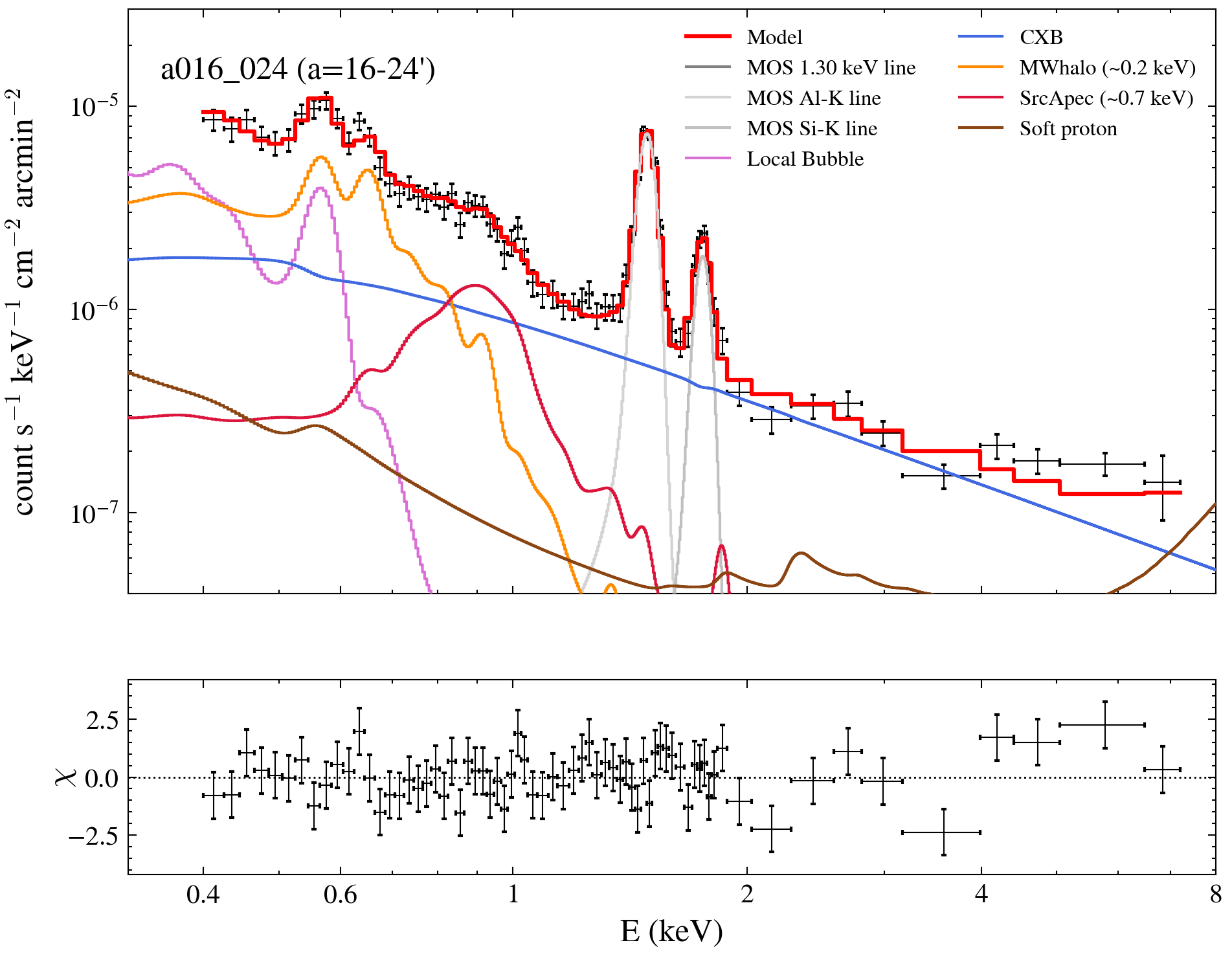
图B:区域 a016_024(最内环,a=16–24′)no_background 联合拟合的一条代表性谱(theo-exp-example-fit-spectrum)——这个环共 28 条 MOS1/MOS2 谱一起拟合共享同一组 LB/MWhalo/SrcApec 全局参数,这里只画统计量最好的一条(SRC_a016_024_0763120101_mos2,ObsID 0763120101)以保持可读,联合拟合 statval=944.49(chi2gehrels),dof=821.黑点是数据,红色粗线是总模型,其余细线是拆开看的模型成分:紫色 Local Bubble(本星系群前景连续谱)、橙色 MWhalo(~0.2 keV,这个环里 kT=0.218 keV)、深红 SrcApec(~0.7 keV,本 draft 的主角,这个环里 kT=0.901 keV,对应〈理论预期〉图3 里核球区的温度峰值)、蓝色 CXB、灰色系三条 MOS 仪器线、棕色 soft-proton.这是一次只读展示,没有重新拟合或改动任何参数.
SrcApec 是单一 APEC,而真实冕星是多温谱。可证伪:跑 2T 恒星模板,看 χ² 是否显著改善、kT 的径向趋势是否消失。conf()(E033 已对晕场这样做)。M/L_W1=0.6、总 SFR=0.3 M☉/yr 是采用而非测量的值(theo-exp-assumptions)。可证伪:独立 SED/颜色定 M/L,独立 FUV+24μm 定 SFR 图。理论预期部分的完整推导(每个换算公式、每个符号的物理意义与单位)见下一节和 [[I020_theoretical_expectation_0p2_0p7kev_budget]];此处只给出假设清单,不重复推导.
完整推导见 [[I020_theoretical_expectation_0p2_0p7kev_budget]];本节持续修订中(详见 changelog),最近几轮包括:Codex adversarial review 订正图4统计错误、排除不可信的 a=92′、量化温度结构显著性、把 sector 开口改为对称 90°、重新纳入 a=56–64′(标注 rstat 偏高)、加上 sector 内的无模型 band flux 剖面——不是文字润色,每一轮都是真实数字或结论的改动.
本节下面所有曲线都建立在两件"看得见"的方法论事实上:区域到底怎么画、拟合到底长什么样。这两张参考图放在〈方法〉一节(图A:区域设计 overlay 在 W1/W4 图上;图B:a016_024 的示例 no_background 拟合谱,theo-exp-region-design-overlay, theo-exp-example-fit-spectrum),不在这里重复,但组会汇报时建议先过这两张图再看下面的预言曲线对比.
在进入任何数字之前先回答一个更基本的问题:为什么"恒星本底"该追踪 M*、"SF 反馈"该追踪 Σ_SFR、"弥散晕/前景"该大致是个平的底——这三条经验关系不是凭空选的统计相关,背后各自有具体的物理图像。不先讲清楚这个,后面的"观测曲线更像哪条预言曲线"就只是在比数字,学不到东西。
精确:这层辐射的物理载体是被点源掩模剔除掉的、大量未分辨的激变变星(CV)、冕活动双星等致密/磁活动系统的叠加光谱,是一个多温混合(典型单个系统 kT 从零点几到几 keV 不等),SrcApec 单温 APEC 只是这个混合谱的一个有效描述,不代表真的只有一种温度的气体(这正是〈关键假设〉里"单温恒星本底"那条要跑 2T 模板检验的原因)。因为这类系统的数量按定义正比于恒星数目,L_X/M\* 这个比值对同一类型的老年星族应该近似是个常数——这正是 Ponti+2026 用银河系西半天球定标出 L_X/M\* 关系、本节直接拿来做预言曲线的物理依据(ponti2026-lxm)。可证伪预期:这条关系应该主要看总恒星质量,不应该强烈依赖局域的近期 SF 活跃程度(年龄>~1 Gyr 后对年龄、金属丰度只有弱依赖)——如果观测到的"恒星本底"强度反而跟着 Σ_SFR 的空间分布走,那就说明它不是这个起源.
精确:能量来源是大质量星风和 II 型/Ib/c 型超新星的机械能注入,把周围 ISM 加热到約 10⁶–10⁷ K(对应約 0.1–0.7 keV,与 SrcApec/MWhalo 覆盖的温度区间重叠,这正是两个模型标签的物理起源本来就难以从单点谱拟合区分开的原因,见〈背景〉里 E×P×A 框架提出的动机)。Mineo et al. 2012b 发现这层弥散热 ISM 有两温结构:⟨kT⟩=0.24 keV 几乎所有取样星系都有(更冷、更弥散的一相,很可能是被吹出较远、已经部分冷却/混合的气体),⟨kT⟩=0.71 keV 只在约三分之一星系里出现(更热的一相,更可能对应还在被恒星风/超新星直接驱动的局域超泡)——这个双温结构不是拟合技巧,是真实的物理分层,也是本节要求"apples-to-apples"匹配温度、不能把 Mineo 关系随便拿去跟任意一个模型标签比的原因(mineo2012b-lxsfr)。可证伪预期:这层辐射的空间分布该跟着 Σ_SFR 走,包括方位角方向——同一半径上,旋臂(SF 活跃)应该比臂间(SF 不活跃)更亮;这是 E×P×A 框架里 A(方位角切分)层还没做、留在〈下一步〉的检验.
精确:这团气体的特征温度由星系晕的维里温度设定(对银河系/M31 这个质量量级的暗晕,量级在 10⁶ K 左右,对应約零点几 keV),是本节 MWhalo 组件覆盖的能段。因为它不是被局域最近的恒星形成或恒星质量分布直接驱动的,最干净的独立测量方式是找一批不经过 M31 明亮盘面的视线(M31CGM 的纯晕场,投影半径 10.5–30.8 kpc,见 m31cgm-080073-halo-field-radii),量出的强度当作这层"平底"的基线,再从盘上的观测里扣掉——这正是〈MWhalo 不是单一成分〉一节做的事,也是为什么这个起源不能像另外两个那样直接画一条"追踪某个 WISE 波段"的预言曲线:它的预言本身就是"大致不随位置变化的一个常数",可证伪预期是残差(扣本底后)应该跟局域 M*、Σ_SFR 都没有系统性的相关,如果有,说明这个起源的模型(或者本底本身的均匀性假设)需要修正.
三条物理图像给出三个可检验的、互相不同的空间/温度签名:起源一(恒星本底)预言强度剖面形状该贴近 Σ_*(核球亮、外盘暗,随方位角基本不变);起源二(SF 反馈)预言强度剖面该贴近 Σ_SFR(旋臂亮、臂间暗,随方位角有起伏),温度該落在 Mineo 给出的两相范围;起源三(弥散晕/前景)预言一层与位置基本无关的平底,温度該落在维里温度量级、全程稳定。下面几步就是把这三个预言分别转成本项目实际量得出的数字,跟 SrcApec/MWhalo 两条观测剖面逐条对比.
SrcApec(0.7–0.9 keV)和 MWhalo(0.19–0.22 keV)都只是模型标签,不预设物理起源。三个候选起源——恒星本底(追踪 M*)、SF 反馈热 ISM(追踪 Σ_SFR)、弥散 M31 晕/银河系前景——各自有独立的经验标定关系,代入同一批环的 WISE 光度算出预言曲线,再和观测叠图.
拟合给出的 norm 只在给定 kT、丰度、能段下才有物理意义,换算成面亮度需要对 SrcApec(Z=1)和 MWhalo(Z=0.3)分别做 Sherpa/XSPEC 数值积分——丰度不同,换算系数不同,这是第一版漏掉、后来订正的具体错误.
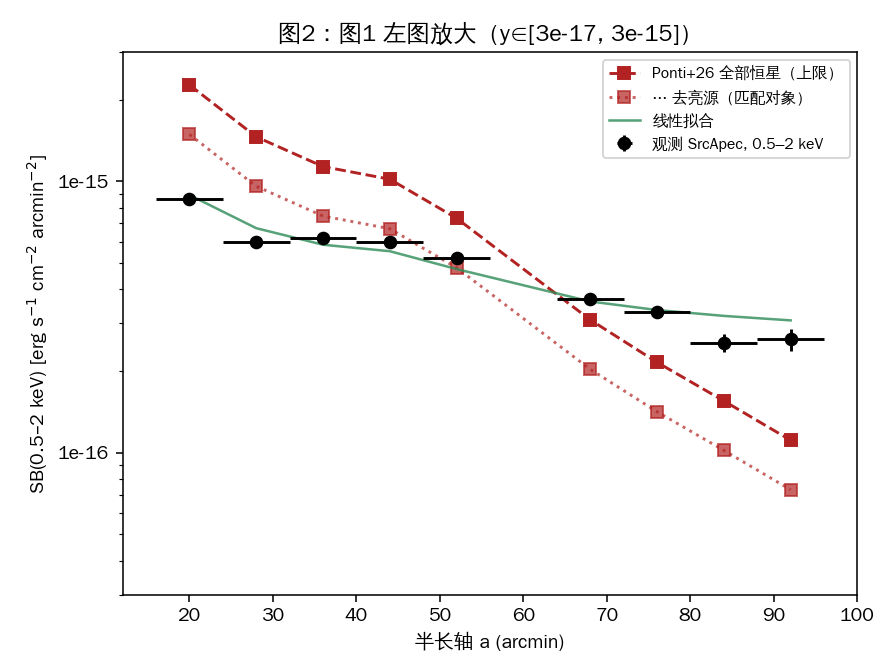
精确:Ponti+2026 的"全部恒星"(1.05e28)和"去亮源"(6.9e27)都来自同一批银河系西半天球数据,区别只是有没有先剔除探测到的银河系亮点源再拟合。M31HotISM 自己的 SrcApec 提取本身已经用点源掩模剔除了 M31 的可分辨亮源(DET_ML>6 排除),所以口径上"去亮源"曲线才是更匹配的比较对象,"全部恒星"曲线该读成一个上限(theo-exp-point-source-removal-methodology).
直接重读两篇原文(不是转引):Ponti 固定 kT=0.7 keV 拟合,L_X/M* 就是这一个 APEC 分量自己的面亮度,和 SrcApec 温度、丰度定义方式一致,这半边比较没问题。Mineo+2012b 的热 ISM 是两温结构:⟨kT⟩=0.24 keV 几乎所有样本星系都有,⟨kT⟩=0.71 keV 只在约 1/3 星系出现,论文给的 L_X(0.5–2 keV)/SFR=8.3e38(mineo2012b-lxsfr,此前误引 已撤回的未经核实旧值,已订正)是两层合在一起、未扣亮源污染的表观值——主导温度是 0.24 keV,该拿去跟 MWhalo 比,不是跟 SrcApec 比(第一版比错了分量,已改).
PI 复核后明确指示:a=88–96′(环中点 a=92′)这个环的结果不可信,本节以下所有讨论、拟合、图都不再使用它,只保留原来 10 个环里的 9 个(a=16–88′,含重新纳入并单独标注 rstat 偏高的 a=56–64′,见下,theo-exp-a092-excluded-unreliable)。查它自己的拟合记录能看到原因:SrcApec kT 的条件误差上下极不对称——上误差 0.189 keV,下误差只有 0.019 keV,差了近十倍,这是这个最外、最暗的环在这个参数上没被数据真正约束住的信号(整体拟合的 rstat=1.33 本身倒不突出,和相邻的 a080_088 环差不多,单看这个统计量看不出问题)。
a=56–64′重新纳入(PI 2026-09-11:"加进去,标注 rstat 偏高"):这个环此前(2026-09-07)因拟合质量被排除在外,一直是剖面上的一个缺口。2026-09-10/11 用当前生产 worker(与其余 9 个已接受环同一份脚本)对 run6 已提取的谱重新拟合,结果和 2026-09-04 的旧拟合逐位数字一致(statval=1882.94, dof=1164, rstat=1.618)——说明这不是"用了过时流程"的问题,是这个环真实、可重复的拟合质量偏高。但 rstat=1.618 只比现有 9 个环里最高的 a064_072(1.552)高约 4%,不是断崖式的离群点(对比 a=92′ 那种明显异常),其 kT 条件误差不对称(−0.008/+0.045,约5.3倍)也比已被接受的 a032_040(约21倍)更温和,没有触发同样的红旗。综合下来纳入剖面,标注 rstat 偏高这一caveat(theo-exp-a056-064-included-flagged)。下面图1–图4 全部基于这 9 个环重新生成.
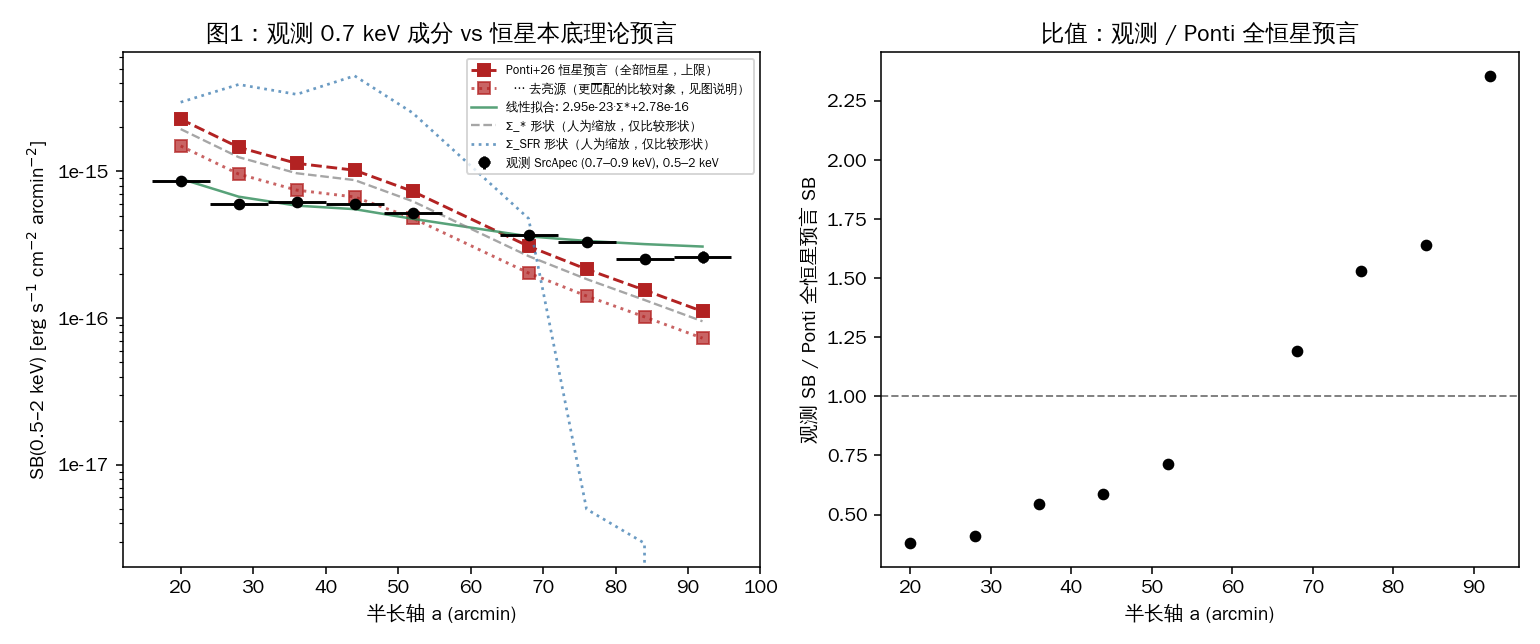
除了 Ponti 的两条物理归一化预言曲线,图1 还新加了 Σ_*、Σ_SFR 本身形状的参考线(灰虚线、蓝点线):各自乘一个单一常数,使其对数均值对齐观测曲线,只比较形状,不依赖 M/L_W1、SFR_total 这两个采用值的绝对大小(theo-exp-shape-reference-curves)——这是一个不依赖假设的视觉检验:不管 M/L 猜得对不对,观测曲线的形状离 Σ_* 形状更近还是离 Σ_SFR 形状更近,一眼可以看出来.
图2 是图1 左图放大到 y∈[3e-17,3e-15](应要求:宽对数轴要容纳 Σ_SFR 曲线在外区的陡降,压缩了真正有信息量的交叉区间)。结果不变:观测/Ponti-全恒星预言之比从 0.38 升到 1.64,在 a=60–68′ 之间穿过 1(theo-exp-obs-vs-predicted-profile;已排除不可信的 a=92′,见下;这个交叉区间因为 a=56–64′ 补进来而比早先估计的 52–68′ 更窄了).
精确:线性拟合 SB=k·Σ_*+C 给出 k 和 C 都是高信度非零(k 约 23 倍于自身误差,C 约 30 倍于自身误差),但拟合本身统计上并不好(χ²/dof=56.4/7≈8);改用不带常数项的纯幂律 SB=A·Σ_*^α,拟合明显更好(χ²/dof=27.0/7≈4,卡方掉了近一半),指数 α=0.385±0.017——明显次线性,不是 α=1 的"严格正比于恒星质量"。(theo-exp-srcapec-not-purely-stellar)。三条证据放在一起:(1) 幂律比线性+常数更能描述形状,说明这一层不是"恒星比例项+独立平坦底"这么简单的叠加;(2) 观测/Ponti 预言之比本身从 0.38 一路爬升到 1.64,不是一个常数——如果这一层严格按 Ponti 那条"恒星年龄无关、到处一个比例"的关系走,这个比值应该到处差不多;(3) α=0.385 这个次线性指数本身也不是恒星数目应该给出的"正比"关系。综合起来:SrcApec 确实和 Σ_* 强相关(不是巧合),核球区大致贴近 Ponti 的"去亮源"预言,支持内区以老年星族为主;但外区比值持续走高、形状更接近幂律而非"比例+平底",说明外区还有 Σ_* 单独解释不了的部分——不能简单读成"基本都是老年星族贡献",这也是〈第一步〉里核球 kT 异常和 Mineo 0.71 keV 热相未定标的两个开放问题仍然重要的原因.
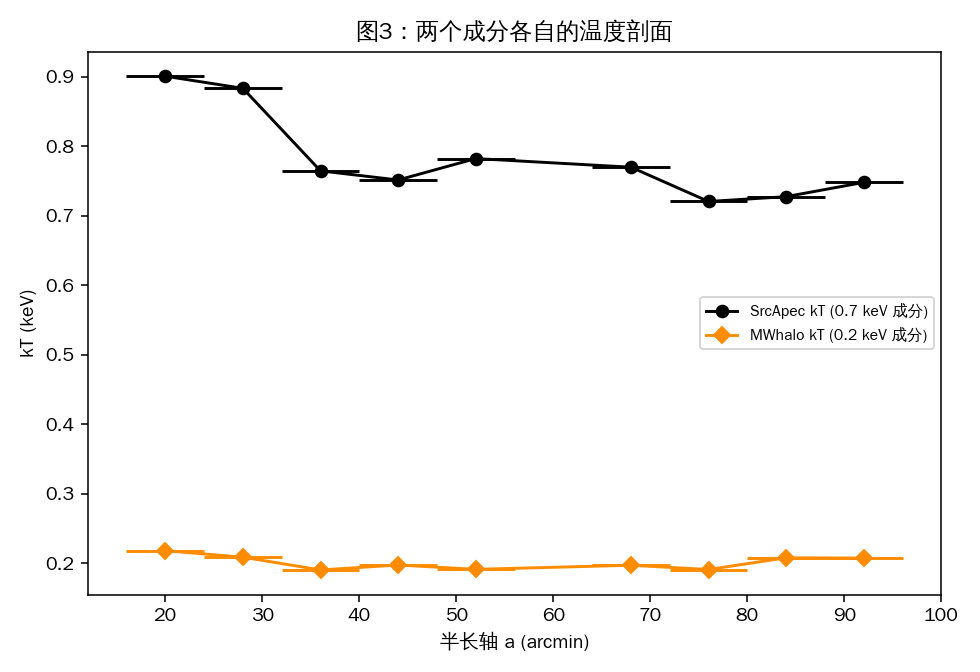
SrcApec 的 kT 在核球/内盘区(a=20′)达到 0.90 keV,到 a=36′ 陡降到 0.76 keV,此后在 0.71–0.78 keV 之间波动(a=56–64′ 的 0.71 keV 现在是这段里的新低点,纳入时标注了 rstat 偏高,theo-exp-a056-064-included-flagged),没有更明显的单调趋势;MWhalo 全程在 0.19–0.22 keV 波动(theo-exp-kt-profile-bulge)。核球区更高的 SrcApec kT 是一个本节没有解决、但值得单独讨论的物理问题:候选解释包括核球更高的 SNIa 速率/Σ_SFR、核球更深的引力势阱压缩加热气体、或核球老年高金属丰度星族本身冕活动更强——这三种解释目前都只是候选,区分它们需要核球区独立的 SNIa 速率或 Σ_SFR 证据,本节不下判断.
精确:把 9 个可信环分成核球组(a≤28′,2 环)和盘外组(a=36–84′,7 环,含新纳入的 a=56–64′),用每环自身对称化的条件误差做逆方差加权平均后比较:SrcApec 核球 0.891±0.011 keV,盘外 0.760±0.010 keV,台阶 0.131±0.015 keV(盘外值的17.2%,8.58σ);MWhalo 核球 0.2125±0.0013 keV,盘外 0.1937±0.0006 keV,台阶 0.0187±0.0014 keV(盘外值的9.7%,形式上 13.20σ)(theo-exp-kt-bulge-outer-significance)。两者不能直接按 σ 数值比较可信度:MWhalo 的台阶在绝对值上比 SrcApec 小一个量级,但其条件误差更小,说明这个参数在联合拟合里被约束得"过于自信",与更亮的 SrcApec 分量之间很可能存在拟合串扰,形式显著性大概率被高估。单独检验此前怀疑的 a=52′ 局域凸起(相对内侧 a=44′,0.782±0.016 对 0.751±0.025 keV,差 0.031 keV)只有 1.04σ,不是稳健的独立特征(theo-exp-kt-bulge-outer-significance)。结论:SrcApec 的核球台阶是本节里唯一在物理上站得住的温度结构性证据;MWhalo 基本平坦这一定性判断仍然成立,只是不能再说它"完全没有对应特征",而应说"有一个远小得多、且可信度存疑的回声".
精确:M31CGM 独立测出的 20 个纯晕场(投影半径范围见 m31cgm-080073-halo-field-radii)MWhalo 拟合,给出前两层混合的最佳本底估计:逐场用各自的 kT 换算到 0.5–2 keV 后取逆方差加权均值,1.351e-15±9.585e-17 erg/s/cm²/arcmin²(mwhalo-baseline-m31cgm)。这是本节上一版的分析错误:直接拟合盘上原始 MWhalo 对 Σ_* 的幂律关系(得到 α=0.264,拟合本身很差,χ²/dof=104),当时被读成"MWhalo 不太追踪恒星质量"——但真正的问题是回归对象本身就没扣掉这个量级相当的本底,那个幂律拟合和斜率数字已撤回,不再使用.
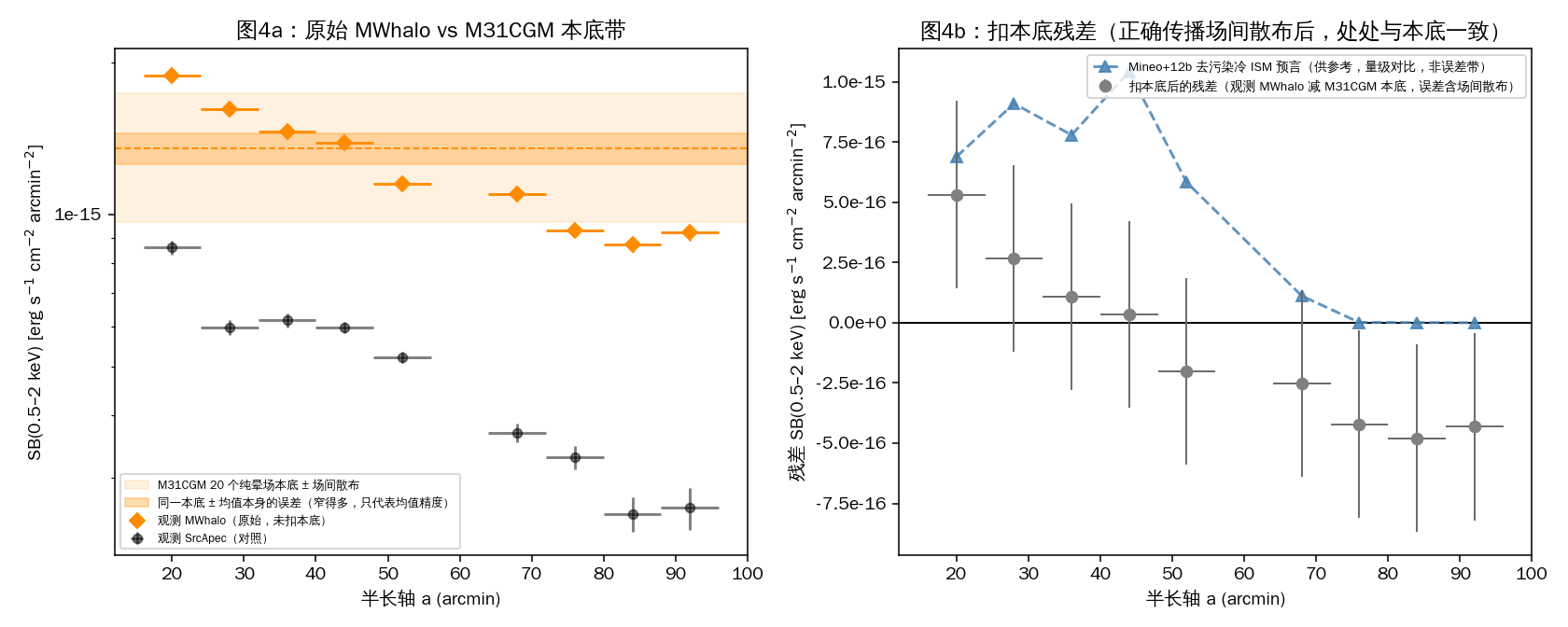
精确:上一版把残差显著性的分母只用了本底加权均值自身的标准误差(9.585e-17),而不是 20 个场之间的场间散布(field-to-field scatter,3.875e-16,约为前者的 4 倍)——前者回答的是"这 20 个场的均值本身有多准",不是"任何一个新视线的本底该有多大范围内波动",后者才是这里真正该用的量(mwhalo-baseline-m31cgm)。用前者算出的"a=20′ +5.21σ 超出""a=92′ −4.23σ 亏缺"这些数字都是虚假的高显著性(mwhalo-residual-significance-pattern)。改用场间散布重算(同时排除下文说明的不可信的 a=92′ 环,纳入重新拟合并标注 rstat 偏高的 a=56–64′),9 个环的残差都落在 |σ|≤1.37 以内,没有一个环统计显著地偏离本底(mwhalo-residual-consistent-with-baseline)。上一版据此提出的"盘内尘埃/HI 吸收压低外区本底"假说,连同它想解释的"亏缺"一起撤回——根本没有需要吸收来解释的亏缺(mwhalo-outer-deficit-absorption-hypothesis,已标记 RETRACTED).
这处订正是 2026-09-10 一次 Codex adversarial review 的结果,由 PI 的怀疑直接触发:不是常规复查,是针对"这个结论对不对"专门派出的挑战式复核.
精确:换算 norm→SB 这一步,本节从头到尾用的都是不含吸收的转换(apec_flux_per_norm(nH=0)),盘上和 M31CGM 晕场两边用的是同一个约定——单看这一步是一致的。真正的不一致藏在更上游:拟合本身给 norm 加了多大的前景吸收。盘上 no_background 拟合把前景吸收固定在 nH=0.03(10²² cm⁻²),M31CGM 这 20 个晕场各自用的是自己视线方向的 HI4PI 实测值(范围 0.048–0.076,均值 0.0585,约是盘上取值的 1.9 倍)(mwhalo-nh-mismatch-caveat)。在 ~0.2 keV 这种吸收截面很大的软能段,假设的前景柱密度偏低,会让拟合出的本征 norm 系统性偏低(模型里吸收得不够,要靠更小的本征辐射就能解释同样的观测计数)——方向是让盘上数值相对本底"显得更暗".
图4a 的棕色方块是一个保守的一阶改正:只把盘上口径拉到跟 M31CGM 晕场本底自己用的 nH 一致(乘以约 1.20 倍),不是重新拟合。改正后(图4b)a=20′ 的残差升到约 2.26σ,是全剖面唯一越过常规 2σ 门槛的环,其余环仍与本底一致.
但这仍然只是下限,不是答案:直接在盘上 9 个环各自的位置查同一张 HI4PI 全天图(而不是套用晕场那套值),读出的 nH 是晕场均值的 1.7–3.4 倍——比本图用的 1.20 倍大得多,而且随半径系统性下降,晕场那个"全场一个数"的简化假设明显不适用于盘上。但这个更大的数字几乎肯定不能直接当吸收改正用:HI4PI 给的是速度不分辨的全天中性氢柱密度,指向 M31 明亮盘面的视线必然会把 M31 自己的 HI 盘也积分进同一个数字里,不只是银河系前景——直接拿这个数字去修正,很可能把 M31 自己的气体也当成"挡在前面的前景"重复扣了一遍,过度改正。要把这两者分开,需要速度分辨的 HI 数据(银河系前景和 M31 自己的气体系统速度差了几百 km/s,原则上可分),或者用一个"前景+M31 内部"两层吸收体的模型重新拟合——这两者本节都还没做,是目前 MWhalo 分析里最大的未解决系统误差来源.
这处检查也顺带回答了 PI 的"flux vs luminosity"提醒:本节全程比较的是去吸收后的本征面亮度(不是任意一方的观测/吸收流量),两边用的转换公式相同;真正需要对齐的不是这一步换算,是上游拟合各自假设了多大的前景吸收——这正是本节这一次检查揪出来的问题.
精确:4 个 sector 现在直接在投影天球面上定义:2 个"平行于盘"(跨大轴,PA=37.7°±45° 及其对面)、2 个"垂直于盘"(跨小轴、朝向晕,PA=37.7°+90°±45° 及其对面),各占 90°,合计 360°(theo-exp-sector-design-halo-extension)。sector 开口变了,但另一件事没变:如果垂直于盘 sector 里的一个点在盘内偏移为零、只是离开盘面的高度为 Z,它投影到天球短轴方向对应的椭圆半径仍满足 Z=a·cot(i)=a×0.292(外层冻结几何 q=0.280, PA=37.7°,i=arccos(0.280)=73.7°,cot(73.7°)=0.292)——这是半径标签 a 沿短轴方向的物理含义,与 sector 开口多宽无关。因为 M31 倾角相当大,要真正探到 Z=10 和 20 kpc 的高度,需要 a 分别推到约 150′ 和 300′(用本项目已有的 10 kpc≈43.7′ 换算),前者还在当前变 W1 几何验证到的 a≤180′ 范围内,后者已经超出。
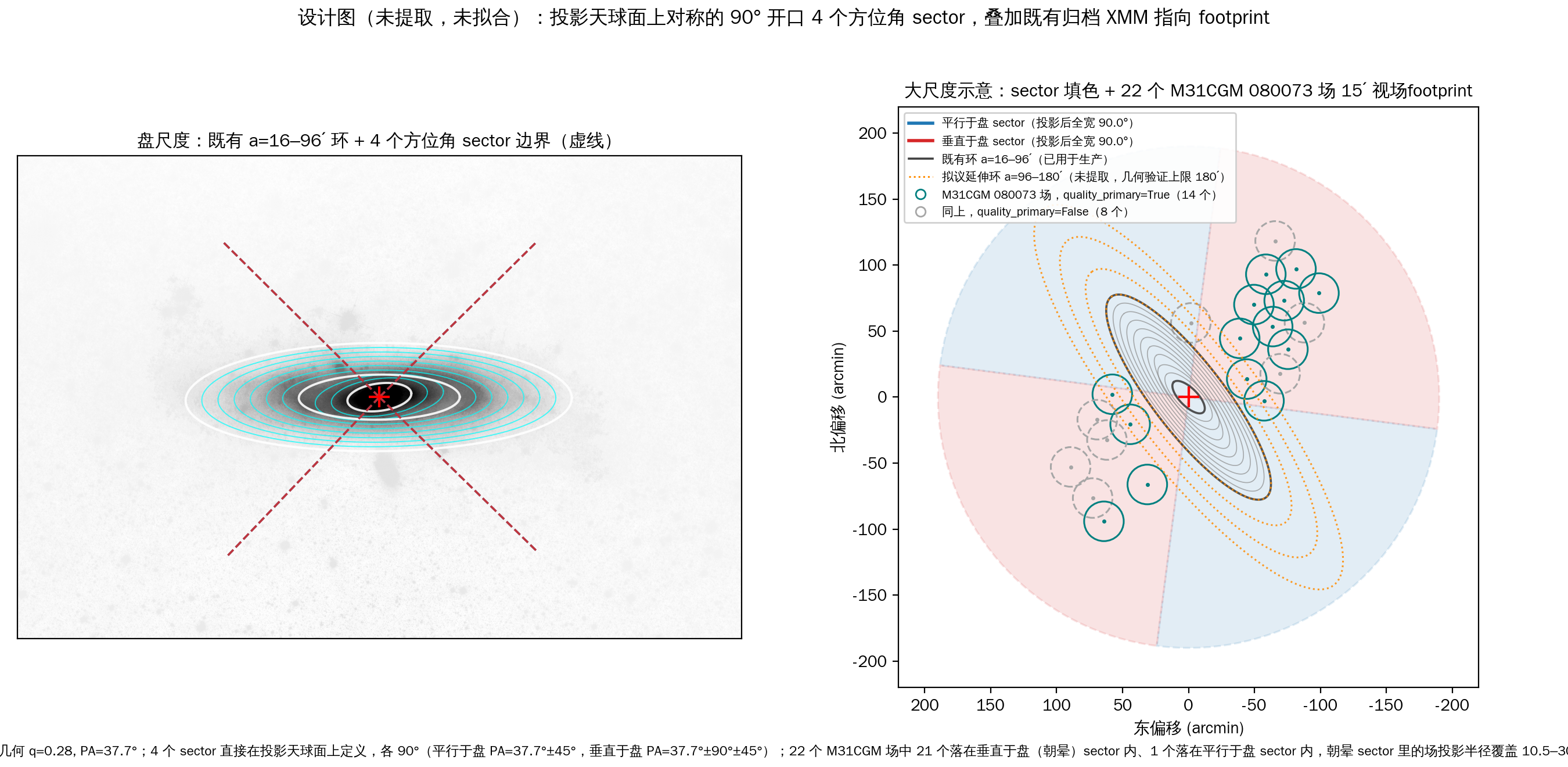
把这 4 个对称 90° sector 的边界和 M31CGM 080073 计划的 22 个纯晕场指向(只读复用其公开的 OBSID/RA/Dec/投影半径元数据,不读取它任何已拟合数值)叠在一起检查发现:21 个场落在"垂直于盘"(朝晕)的两个 sector 里(14 个 quality_primary=True,7 个 quality_primary=False),只有 1 个(0800731301,投影半径 12.9 kpc)落在"平行于盘" sector 里,21 个朝晕场覆盖投影半径 10.5–30.8 kpc(theo-exp-sector-design-halo-extension)——归档里仍然有大量指向落在正确的天球方向、半径也覆盖了 PI 要求的 10–20 kpc 区间,不需要新申请观测就能先试。
按 PI 定的规则逐个环检查已有 OBSID:先看这个 OBSID 在某个环里的视场重叠落在哪个/哪些 sector 里——如果同时落在两个正对面的"垂直于盘" sector(说明这个谱把盘两侧的光混在了一起),跳过;如果只落在一侧,哪怕溢出到邻近的"平行于盘" sector 也先接受。把这条规则应用到 a=16–128′(含 8′ 精细环和外区 16′ 粗环)全部 10 个环之后,除了 a024_032 这一环东南侧(perpendicular_1)目前没有可用 OBSID(只有西北侧 6 个)之外,其余每个环两侧都至少有 1 个可接受的谱;10 个环里只有 3 个 OBSID 因视场直接横跨两个对面 sector 被拒绝。这一步仍然只是选谱,没有提取任何新区域、没有开任何新谱、没有跑任何新拟合.
精确:revision 2 使用六个统一 16′ 环 a032_048、a048_064、a064_080、a080_096、a096_112、a112_128;前两个宽环也是同一 run6 campaign 已独立发布的区域产品,并非新提取。12 个(环,侧)组合按东南/西北顺序的 ACCEPT OBSID 数为 6/3、10/2、10/4、10/5、9/4、5/4。随后只复用已完成的逐 OBSID、QPB 扣除且经 ARF/RMF unfold 的无模型测量,在每个 sector 内逆方差加权。图D横坐标改用真实的天球短轴投影距离 b=q·a(冻结外层几何 q=0.280),而 a032_048 等 region ID 仍保留为定义椭圆环的半长轴范围(theo-exp-vertical-sector-band-flux-profile)。

四条曲线的外端点都低于各自内端点,但并非单调下降,外区有趋平或回升,尤其西北侧 0.5–0.7 keV 很明显:0.5–0.7 keV 东南侧从 −11.2′ 处 1.44e-06 到 −33.6′ 处 1.10e-06,西北侧从 11.2′ 处 1.19e-06 到 33.6′ 处 1.12e-06;0.7–1.0 keV 东南侧从 8.19e-07 到 5.36e-07,西北侧从 7.46e-07 到 5.22e-07(theo-exp-vertical-sector-band-flux-profile)。到 ±33.6′ 仍不为零并不奇怪:这是 SrcApec、MWhalo、CXB 与残余前景/仪器贡献之和,不能单独确认或排除 SrcApec 趋零。
精确:用符号链接(从不复制数据)为 12 个组合各建一个过滤后的 source_root,交给相同的 fit_m31hotism_annulus_worker.py/no_background 流程。12/12 个真实拟合都通过 accepted_hot_srcapec();rstat 范围为 1.28–2.02。图E同样以 b=q·a(q=0.280)表示真实的天球短轴投影距离,region ID 中的 a 仍只定义椭圆环(theo-exp-vertical-sector-component-flux-profile)。

SrcApec SB(0.5–2 keV) 的东南侧外端较低:−11.2′ 的 6.68e-16 到 −33.6′ 的 3.36e-16,但它在 −24.64′ 达到 2.77e-16 后回升;西北侧非单调,从 11.2′ 的 3.94e-16 先降至 29.12′ 的 1.68e-16,再回升到 33.6′ 的 4.34e-16。MWhalo 同样非单调:东南侧从 −11.2′ 的 1.78e-15 降到 −29.12′ 的 7.91e-16,再反弹到 −33.6′ 的 1.95e-15;西北侧从 11.2′ 的 1.12e-15 到 33.6′ 的 8.03e-16,中间也有平台/小回升。因此 revision 2 没有给出 SrcApec 双侧单调下降,更没有证明它趋于零(theo-exp-vertical-sector-component-flux-profile)。
好消息是第一版的四个 2-OBSID 组合缩减为一个;坏消息是条件 Δχ²=1 误差棒成功率没有提高:revision 2 为 9/12=75%,revision 1 为 12/16=75%。三个无误差棒的硬边界组合是 a080_096__perpendicular_2、a096_112__perpendicular_2(SrcApec kT=1.0 keV 硬上限)和 a112_128__perpendicular_1;唯一的 2-OBSID 组合反而成功得到误差棒,所以不能把硬边界简单归咎于 OBSID 数。作为物理量级检查,对 a032_048–a080_096,把对应两条 8′ 整环 SB 按椭圆环面积代理权重 a_out²−a_in² 合并,sector/整环比为 0.65–1.26;超过整环剖面 96′ 上限的两环只能临时对比最近的 a088_096,范围为 0.64–2.12,最大 2.12 来自东南侧 a112_128 的 MWhalo。没有数量级偏差,但 >96′ 的对比是外推,且 a088_096 自身曾被标为不可信,必须保留警告(theo-exp-vertical-sector-component-flux-profile)。
SrcApec 超出恒星预言的部分(图1 右图 a≥64′ 处比值>1)是否是这一热相的贡献,目前无法用文献数字直接检验。SrcApec kT=0.90 keV 的三个候选解释仍未取舍,需要独立证据.MWabs, nH=0.03),理论上会受一样的系统性偏低影响;但和它比较的 Ponti+2026 关系用的是 Ponti 自己银河系定标样本的吸收口径,本节还没去核对那个口径具体是多少,无法判断是否需要类似的修正.都留在〈未走的路〉〈开放问题〉里.
| 结果 | 置信度 | last_verified |
|---|---|---|
| E×P×A 框架 + 变 W1 几何 | ✅ validated | 2026-07-10 (variable-w1-geometry) |
| run6 规模化提取:490 套完整产品/252 组合 | ✅ validated | 2026-08-30 (run6-product-inventory) |
9 点 8′ 环 SrcApec + MWhalo 剖面 |
✅ validated | 2026-09-09 (srcapec-9pt-profile, mwhalo-9pt-profile) |
| 0.7 keV vs 恒星预言:观测/预言比 0.38→1.64,a=60–68′ 穿过 1(已排除不可信的 a=92′,纳入标注 rstat 偏高的 a=56–64′) | 🟡 active | 2026-09-11 (theo-exp-obs-vs-predicted-profile) |
| 温度剖面:核球 kT=0.90 keV 陡降到外盘 0.71–0.78 keV;MWhalo 全程持平(有一个小得多、可信度存疑的台阶回声) | 🟡 active | 2026-09-11 (theo-exp-kt-profile-bulge) |
| 垂直于盘方向 sector:revision 2 统一 16′ 后,横轴采用真实投影距离 b=q·a(q=0.280;region ID 仍按 a 定义);无模型 band flux 四条曲线外端均较低但外区趋平/回升,仍不掉零 | 🟡 active | 2026-09-12 (theo-exp-vertical-sector-band-flux-profile) |
| 垂直于盘方向 sector:横轴采用真实投影距离 b=q·a(q=0.280;region ID 仍按 a 定义);12/12 联合拟合通过,SrcApec 两侧均非单调,未确认趋零(3/12 无误差棒,成功率仍 75%,rstat 最高 2.02) | 🟡 active | 2026-09-12 (theo-exp-vertical-sector-component-flux-profile) |
| MWhalo 本底(M31CGM 20 纯晕场加权均值)与扣本底残差(正确传播场间散布后:处处与本底一致) | 🟡 active | 2026-09-10 (mwhalo-baseline-m31cgm, mwhalo-residual-consistent-with-baseline) |
| E033 完成:晕场固定 kT=0.7 前景 90% 上限 1.6559e-8,20/20 场与零一致 | 🟡 active | 2026-09-10 (e033-joint-branchB, e033-individual-branchB) |
| E033 完成:晕场放开 kT 点估计显著(kT=0.773),但置信区间计算失败(非"未出") | 🟠 proposed | 2026-09-10 (e033-joint-branchC) |
读法:前三行是地基。中间三行是理论预期分析的直接产出,包含四次自我订正:(1) Mineo 关系的主导温度是 0.24 keV 而非 0.71 keV,该拿去跟 MWhalo 比而非 SrcApec;(2) MWhalo 是 MW 前景+M31 CGM+可能的盘内成分三者叠加,直接拿盘上原始 MWhalo 回归 Σ_* 是无效分析,已改用 M31CGM 独立测出的纯晕场本底做扣除,只对残差做解读(theo-exp-mwhalo-srcapec-slope-comparison 与 mwhalo-vs-mineo-inner-outer-contrast 两条旧结论已撤回);(3) 由 PI 对"外区亏缺"的质疑触发的 adversarial review,发现上一版残差显著性用错了本底不确定度(该用 20 个场之间的场间散布,不是均值本身的标准误差),改正后原本的"内区显著超出、外区显著亏缺"消失,8 个可信环全部与本底一致(mwhalo-residual-significance-pattern、mwhalo-outer-deficit-absorption-hypothesis 两条旧结论已撤回,见 mwhalo-residual-consistent-with-baseline);同一次复核还留下一个部分订正的口径问题——盘上固定 nH=0.03,晕场各自用更高的 HI4PI 实测值,已做保守一阶修正但仍是下限(mwhalo-nh-mismatch-caveat);(4) PI 认定 a=92′ 环不可信,已从全部讨论中排除,剩 8 个可信环(theo-exp-a092-excluded-unreliable);(5) 最新一次——另一个此前因拟合质量被排除的环 a=56–64′,重新拟合确认问题真实但不算离群后,标注 rstat 偏高重新纳入,剩 9 个可信环(theo-exp-a056-064-included-flagged)。最后两行是 E033 的最终裁决:固定温度分支支持"无 Ponti 尺度前景底";放开温度分支的点估计显著但置信区间计算真实失败(10 小时 CPU 上限终止),只能标为疑似。
Aold·Σ_W1 + Ayoung·Σ_W4dust + C,因为这比"先分环拟合、再事后回归 9 个点"统计上更干净。但设计矩阵条件数达 378(W4dust 在所选窗口内几乎空间常数),且该战役(2026-09-07 run2)三个模式都未跑完就中止,没有任何可信结果(old-young-template-run2-abandoned)。当前改用更简单但已完成的"先拟合剖面、再回归 9 点"路径。MWhothalo=(7.4±1.1)e-8(m31cgm-v18-mwhothalo),量级和本 draft 早期的线性拟合底吻合,一度被当作交叉验证.但 v18 本身是 Provisional(χ²/dof=1.70,N_H 全场固定 0.03),不满足独立验证的门槛,所以改为专门发起 E033,用与盘完全相同的模型、逐场 HI4PI N_H 重新测量,而不是复用 v18 数字.SrcApec 假设未受挑战前直接采信 kT 径向趋势:核球 kT=0.90 到外盘 kT=0.71 的下降本身就是有趣的信号,但在跑 2T 恒星模板之前,不排除是单温近似对真实多温冕星谱的系统性拟合伪影,故〈理论预期〉一节未把它当作独立证据使用.SrcApec(0.7 keV)比:第一版理论预期图就是这么画的。重新核对 Mineo 原文后发现该关系的主导温度是 ⟨kT⟩=0.24 keV(几乎所有样本星系都有),⟨kT⟩=0.71 keV 分量只在约 1/3 星系里出现且论文未给出单独归一化——这个关系天然更该拿去跟 MWhalo(0.19–0.22 keV)比,而不是 SrcApec。已改画(theo-exp-mwhalo-srcapec-slope-comparison,mwhalo-vs-mineo-inner-outer-contrast),第一版"SF 反馈基本不贡献"的结论已撤回。MWhalo(未扣本底)直接拿去和 Σ_*/Σ_SFR 做回归或比斜率:这是本 draft 第二版的做法(α=0.264 的幂律拟合),经 PI 指出后核实:MWhalo 是 MW 前景、M31 CGM、可能的盘内局域成分三者沿视线叠加的结果,前两者没有理由追踪盘上局域的 Σ_*,直接回归混合量等于假设前两者为零。已改用 M31CGM 独立测出的纯晕场本底做扣除,只解读残差(mwhalo-baseline-m31cgm);第二版的斜率数字和"内区同量级、外区脱钩"的结论均已撤回。MWhalo 简并的假象?置信区间计算本身已失败(10 小时 CPU 上限终止,e033-joint-branchC),半数以上场次 kT 贴 [0.5,1.0] 边界,是当前最大的风险信号——需要换一种更便宜的方法(粗网格扫描、bootstrap,或干脆先接受协方差估计并明确标注非轮廓似然)才能往前推进。angr(o-abundance-angr-vs-wilm),M31Center 最初 RGS 探测的物理真实性问题(07kev-physical-reality)本身属于 M31Center 项目,不由本 draft 的分析回答.SrcApec 超出恒星预言的部分(图1 右图 a≥64′ 处比值>1)是否是这一热相的贡献,目前无法用文献数字直接检验,只能等自有多温分解或方位角检验.conf() 在这个联合模型上 10 小时未收敛被强制终止。是否授权用更便宜的替代方法(分场/分组的粗网格扫描,或协方差估计+明确标注局限)先拿到一个可用区间?还是把 kT=0.773 这个点估计暂记为"疑似",等方位角一致性检验的独立证据再决定要不要把它当作 S04 三成分分解的正式起点?conf() 轮廓似然误差,替换当前的条件 Δχ²=1,再重新评估图中比值和斜率差异的显著性。每个术语:先给一句直觉,再给可审查的精确定义。narrative 正文第一次出现术语时可只挂链接到此表;这里没有的术语,正文必须内联定义。
精确定义:Sherpa/XSPEC 中一个 XSapec 组件,代表沿视线方向除银河系 MWhalo/LB/CXB 之外的剩余热成分;本项目里 kT 通常自由(0.5–1.0 keV 先验),丰度固定 Z=1(angr)。它不预设物理起源——"SrcApec"只是模型标签,是否等于 M31 CGM、恒星本底残余,还是银河系前景,是待检验的问题,不是定义的一部分。
精确定义:MWhalo:kT 自由 0.10–0.35 keV,Z=0.3,代表银河系 CGM + 可能的 M31 内晕沿视线叠加(不是纯银河系的干净测量,见 M31CGM 的 [[I006_m31_mw_line_of_sight_degeneracy]])。MWhothalo:kT 固定 0.7 keV 的历史命名,在当前 M31HotISM 拟合契约里通常 norm=0 冻结,其角色由自由丰度、自由 kT 的 SrcApec 承担。
angr / wilm 丰度表精确定义:XSPEC 内置的太阳丰度参考表。angr=Anders & Grevesse (1989),wilm=Wilms, Allen & McCray (2000)(星际气体相丰度,O/Fe 比 angr 低)。本 draft 引用的所有 disk/halo APEC 拟合统一用 angr;M31Center 最早的 RGS 探测(kT=0.74, O=1.93, Fe=0.89)用的是 wilm——两者的 O/Fe 数值不可直接比较,这是 [[o-abundance-angr-vs-wilm]] 存疑的原因。
精确定义:xsherpa 的 Fitter 从每个数据集的 BACKSCAL 头信息推导天区面积(arcmin²,Python float),用 scale_skyarea() 把天空模型乘以该面积后再与探测器响应卷积——绝不用 Sherpa 的 Const1D(那是"积分模型",会多算一次能量 bin 宽度,导致归一化系统性错误达 200×,见项目历史 bug)。这保证不同环、不同 ObsID 的 norm 直接可比,是"每 arcmin²"的密度,不是总流量。
conf())精确定义:本 draft 引用的 9 点 disk 剖面误差是条件 Δχ²=1(其余核咎参数固定在鞍点值),来自局部协方差展开,在存在参数简并(如本项目 O-norm 简并)时系统性偏小。E033 对晕场改用 Sherpa conf(),逐点重新优化其余自由参数,是本项目里唯一已经按轮廓似然算出置信区间的结果集。两者不可直接比较误差棒大小;[[theo-exp-assumptions]] 列出这条差异。
精确定义:Ponti+2026 用银河系西半天球定义的经验关系,固定 kT=0.7 keV、Z=Z☉ APEC 拟合表面亮度与恒星质量面密度的相关斜率,见 [[ponti2026-lxm]]。本 draft 把它当作恒星起源的预言曲线,用同一批环的 W1→Σ_* 代入换算,不是重新测量。
精确定义:本 draft 用 W4 逐环流量份额,乘以一个假定的 M31 总 SFR(0.30 M☉/yr),得到 Σ_SFR,再乘 Mineo et al. 2012b 的 L_X(0.5–2 keV)/SFR=8.3e38 给出"如果 0.7 keV 全部来自超新星加热 ISM"的预言曲线,见 [[mineo2012b-lxsfr]]。
精确定义:Elliptical annuli(E0–E5)× Physical masks(P0–P5)× Azimuthal subdivision 的三层正交切分,见 [[epa-hierarchy]]。当前落地的提取只用了 E 层(变 W1 环),P/A 层仍是未来工作。
a,q(a),PA(a)精确定义:以 WISE W1 等照度轮廓拟合出的 45 个嵌套边界(a=4–180′步长4′),每个边界有自己的轴比 q(a) 和位置角 PA(a);a≥40′ 冻结为 q=0.280, PA=37.7°(见实际生产区域文件 native_ellipse_a040_080_q0280_pa377/),细节见 [[variable-w1-geometry]]。
no_background 拓扑精确定义:xsherpa Fitter.fit_template 的一种拓扑(m31hotism.xsherpa-srcapec-matrix.v1 契约字段 topology),区别于 background_anchored(先单独拟合背景场再固定传入)。本 draft 引用的 9 点剖面全部用 no_background。
精确定义:见 [[E033_m31cgm_halo_fields_srcapec_07kev_refit]]。A:SrcApec.norm=0 冻结;B:kT=0.7 keV 冻结,norm≥0 自由;C:kT 自由 0.5–1.0 keV(须大于 MWhalo.kT)。Δχ² 在 A 和 B/C 之间的大小,是"这个温度假设是否被数据需要"的检验。
精确定义:HI4PI 巡天(HI4PI Collaboration 2016)给出的全天银河系中性氢柱密度图,本项目用逐指向的 N_H 值(而不是全场固定一个数)做视线吸收改正;E033 对 22 个晕场逐场取值,是它相对 M31CGM v18(全场固定 N_H=0.03)的关键方法论升级之一。
| id | statement | status | evidence | last_verified |
|---|---|---|---|---|
| 3comp-framework | M31's 0.6–0.8 keV disk emission is decomposed into 3 competing physical origins: (A) unresolved stellar floor, (B) SF-feedback/ISM, (C) diffuse hot halo/CGM. | validated | cognition-os/insights/I001_07keV_origin_decomposition.md | 2026-06-25(尚未复核 79 天) |
| epa-hierarchy | E×P×A three-layer spatial decomposition (elliptical annuli × physical masks × azimuth) enables 3 orthogonal comparisons: fixed-radius/different-physics, fixed-physics/different-radius, fixed-both/different-azimuth. | validated | cognition-os/insights/I002_region_decomposition_framework.md | 2026-06-25(尚未复核 79 天) |
| variable-w1-geometry | Projected radial coordinate uses a variable-W1 isophotal ellipse with 45 nested q(a),PA(a) boundaries, a=4–180′; outer frozen geometry q=0.280, PA=37.7° E of N for a≥40′. | validated | cognition-os/insights/I007_variable_w1_isophotal_radius_and_article_morphology_masks.md; regions/native_ellipse_a040_080_q0280_pa377/ | 2026-07-10(尚未复核 64 天) |
| run6-product-inventory | Campaign run6 reached terminal receipts for all 33 selected ObsIDs (6 full, 27 partial); accepted product set is 490 complete 8-file MOS task bundles (3,920 canonical FITS) across 252 ObsID-region combinations. | validated | cognition-os/02_CURRENT_QUESTION.md (run6 completion update); cognition-os/sessions/2026-08-30_xmm_v161_mos_campaign_template.md | 2026-08-30 |
| 8arcmin-profile-regions | UPDATED 2026-09-11 (was stale since the a=92′/a=56–64′ revisions): the accepted no-background SrcApec profile covers 9 non-overlapping 8′ annuli from a=16′ to a=88′ (a016_024 … a080_088, i.e. a=16–96′'s 9 sub-annuli with a088_096/a=92′ excluded as unreliable — `theo-exp-a092-excluded-unreliable` — and a056_064 included with an elevated-rstat caveat — `theo-exp-a056-064-included-flagged`); a096_112/a112_128 exceed 100′ and a128_144 has no accepted fit. | validated | output/m31hotism_complete_9arcmin_profiles_20260911_run1/complete_8arcmin_no_background_profile.csv; output/m31hotism_complete_9arcmin_profiles_20260911_run1/augmentation_manifest.json | 2026-09-11 |
| srcapec-9pt-profile | UPDATED 2026-09-11 (was stale, described the pre-a=92′-exclusion original 9 points, not the current set). Per-annulus no-background SrcApec best fit, current 9 retained annuli (a=92′ excluded, a=56–64′ included with caveat): kT ranges 0.709–0.90 keV, norm ranges 8.45e-8–3.19e-7 (arbitrary XSPEC-norm units, per arcmin²); vertical errors are conditional Δχ²=1 with saved nuisance parameters fixed, not profile-likelihood intervals. | validated | output/m31hotism_complete_9arcmin_profiles_20260911_run1/complete_8arcmin_no_background_profile.csv | 2026-09-11 |
| apec-flux-per-norm-kt0p7 | For a kT=0.7 keV, Z=1 (angr), unabsorbed APEC, flux per unit XSPEC norm is 3.025e-9 erg/s/cm² in 0.5–2 keV and 3.950e-9 erg/s/cm² in 0.1–10 keV (ratio 0.766). | validated | scripts/compute_m31hotism_0p7kev_theoretical_expectation.py (apec_flux_per_norm, CIAO 4.18 Sherpa/XSPEC); output/m31hotism_theoretical_expectation_20260910_run1/theoretical_expectation_budget.json | 2026-09-10 |
| theo-exp-obs-vs-predicted-profile | 观测 SrcApec(0.7–0.9 keV)与 Ponti-全恒星预言表面亮度 SB(0.5–2 keV)之比,从 a=20′ 时的 0.38 上升到 a=84′ 时的 1.64(排除 a=92′ 后保留的 8 个环中最外的一个,见 `theo-exp-a092-excluded-unreliable`),并在 a=52′ 到 a=68′ 之间穿过 1。(早期版本还曾把 Mineo+2012b 关系直接与 SrcApec 比较;该比较使用了错误的温度匹配成分——Mineo 的 SFR 关系由 ⟨kT⟩=0.24 keV 相主导,而不是 SrcApec 的约 0.7–0.9 keV——现已移至 mwhalo-vs-mineo-inner-outer-contrast。更早的另一个版本还引用了排除该环之前的上界;该环后来被认定不可靠并排除。) | active | cognition-os/insights/I020_theoretical_expectation_0p2_0p7kev_budget.md; cognition-os/draft/figures/theoretical_expectation_profile_fig1.{png,manifest.json} | 2026-09-10 |
| theo-exp-linear-floor-fit | STALE NUMBERS CORRECTED 2026-09-11 (were left over from before the a=92′ exclusion round and never updated; caught during the a=56–64′ re-inclusion audit). Weighted linear fit SB(0.5–2 keV) = k·Σ_* + C, on the current 9 retained annuli (a=92′ excluded, a=56–64′ included with a caveat — see `theo-exp-a056-064-included-flagged`), gives k=(2.808±0.12)e-23, C=(2.972±0.10)e-16 erg/s/cm²/arcmin², χ²/dof=56.4/7 (matches `theo-exp-srcapec-not-purely-stellar`). | active | output/m31hotism_theoretical_expectation_20260910_run1/theoretical_expectation_budget.json (fits.linear_plus_constant) | 2026-09-10 |
| theo-exp-powerlaw-nofloor-fit | STALE NUMBERS CORRECTED 2026-09-11 (same leftover-from-before-a=92′-exclusion issue as `theo-exp-linear-floor-fit`). Weighted power-law fit SB(0.5–2 keV) = A·Σ_*^α with no constant, on the current 9 retained annuli, gives A=(1.209±0.29)e-18, α=0.385±0.017, χ²/dof=27.0/7 — fits distinctly BETTER than the linear-plus-floor fit (roughly half its χ²/dof), not merely comparable; see `theo-exp-srcapec-not-purely-stellar` for the full argument this supports (profile is not simply 'proportional to Σ_* plus a flat floor'). | active | output/m31hotism_theoretical_expectation_20260910_run1/theoretical_expectation_budget.json (fits.powerlaw_no_constant) | 2026-09-10 |
| ponti2026-lxm | Ponti et al. 2026 (A&A, arXiv:2602.03941): low-mass-star L_X/M* = 1.05e28 erg/s/M☉ (0.1–10 keV, all stars, Hunter+24 mass model) or 6.9e27 (bright resolved point sources removed), from a fixed kT=0.7 keV, Z=Z☉ APEC fit to the western Galactic hemisphere (SRG/eROSITA). | active | arXiv:2602.03941 (external literature, not independently re-derived) | 2026-09-09 |
| mineo2012b-lxsfr | Mineo et al. 2012b (MNRAS 426, 1870; arXiv:1205.3715), verified directly from the paper: hot-ISM apparent L_X(0.5–2 keV)/SFR = 8.3e38 erg/s per M☉/yr, of which on average ~30–40% is estimated to be residual faint compact sources rather than pure ISM (pure-ISM estimate ≈5.4e38 at the 35% midpoint). The hot ISM itself is two-temperature: ⟨kT⟩=0.24 keV is present in ALL sampled galaxies (matches this project's MWhalo regime), and a second ⟨kT⟩=0.71 keV component is required in only ~1/3 of galaxies (matches this project's SrcApec regime); no separate per-component normalization is given in the source. An earlier version of this claim cited 已撤回的未经核实旧值 without a verified source; that number is retracted. | active | Mineo, Gilfanov & Sunyaev 2012, MNRAS 426, 1870, arXiv:1205.3715 (abstract read directly, 2026-09-10) | 2026-09-10 |
| mw-foreground-lxm-projection | Back-of-envelope: applying the Ponti+26 relation to the Milky-Way stellar column toward M31 (b=−21.6°) predicts a foreground norm-equivalent of order (0.8–1.3)e-7 arcmin⁻², comparable in order of magnitude to the linear-fit floor C. | proposed | in-conversation estimate, 2026-09-09; not independently re-derived or reviewed | 2026-09-09 |
| e033-individual-branchB | In the 20 fittable M31CGM 080073 halo pointings, fixing SrcApec at kT=0.7 keV (branch B) gives Δχ² relative to norm=0 (branch A) of median 0.22 (max 1.93); all 20 fields have a 90% confidence lower bound of exactly zero — no individual field statistically requires a fixed-0.7-keV component. | active | output/m31hotism_e033_halo_srcapec_refit_20260909_run1/jobs/*/fit_manifest.json (branch_A_srcapec_norm_zero, branch_B_fixed_kT_0p7) | 2026-09-09 |
| e033-joint-branchB | E033 campaign complete. Joint 14-primary-field fit (28 spectra, shared SrcApec) at fixed kT=0.7 keV: norm=8.2064e-9 arcmin⁻², 90% profile-likelihood CI [0, 1.6559e-8] arcmin⁻²; Δχ²(A−B)=2.612 relative to norm=0. NW/SE per-field norm medians 8.9447e-9/4.4464e-9, 90% upper-limit medians 4.4350e-8/4.8153e-8 — no gross NW/SE asymmetry. Verdict: strongly favors H2 (no Ponti-scale flat foreground) over H1; the joint upper bound and even the largest individual-field upper bound (6.037e-8) lie below H1's (0.7–1.3e-7) range. | active | output/m31hotism_e033_halo_srcapec_refit_20260909_run1/e033_summary.csv, e033_report.md; cognition-os/sessions/2026-09-09_e033_halo_srcapec_refit.md | 2026-09-10 |
| e033-joint-branchC | Same joint fit with kT free (0.5–1.0 keV): best fit kT=0.7730 keV, norm=3.3901e-8 arcmin⁻², Δχ²(A−C)=157.257 relative to norm=0 — highly significant point estimate. Its 90% confidence interval computation FAILED, not merely pending: Sherpa conf() remained CPU-active for 10 hours and was terminated at the documented operational boundary, with no covariance or reparameterised substitute used. One pointing (0800731301) separately failed its own branch-C interval (reduced statistic > 3). Per-field kT piles up at the [0.5,1.0] prior boundary in more than half the 20 pointings. Verdict: this point estimate sits between H1 and H2, but the failed interval prevents an independent free-temperature verdict. | proposed | output/m31hotism_e033_halo_srcapec_refit_20260909_run1/e033_summary.csv, e033_report.md | 2026-09-10 |
| m31cgm-v18-mwhothalo | M31CGM's earlier 22-ObsID v18 joint fit gave a fixed-kT=0.7 'MWhothalo' norm of (7.4±1.1)e-8, but that fit is itself flagged Provisional (χ²/dof=1.70, N_H fixed at 0.03 for all pointings, MOS 1.4–2.0 keV not excluded) and should not be used as an independent cross-check until E033 supersedes it. | active | M31CGM cognition-os/insights/I007_joint_fit_baseline_provenance.md | 2026-07-10(尚未复核 64 天) |
| old-young-template-run2-abandoned | A per-spectrum joint decomposition (Aold·Σ_W1 + Ayoung·Σ_W4dust + C, 316 spectra) was planned and started (old_only mode) on 2026-09-07 but never reached a completed fit result in any of its three modes (old_only/young_only/mixed); no number from this run may be cited. | unsourced | output/m31hotism_old_young_template_fits_20260907_run2/ (only MODE_STARTED for old_only; no fit_manifest.fit block) | 2026-09-10 |
| o-abundance-angr-vs-wilm | M31Center's original 0.7 keV RGS fit (kT=0.74, O=1.93, Fe=0.89) used the wilm abundance table; an angr re-fit is needed before O/Fe values from that fit can be compared to the angr-based disk/halo APEC fits in this project. | proposed | cognition-os/00_AI_BRIEFING.md (Currently questioned) | 2026-06-25(尚未复核 79 天) |
| 07kev-physical-reality | Whether the 0.7 keV signal is real M31 emission, MW foreground, or an O-norm fitting degeneracy from the original RGS detection remains unresolved. | proposed | cognition-os/00_AI_BRIEFING.md (Currently questioned) | 2026-06-25(尚未复核 79 天) |
| wise-m31-center | M31 adopted center (RA, Dec) = (10.68479°, 41.26907°), distance D=785 kpc. | validated | cognition-os/insights/I004_jarrett_wise_double_sersic.md (Jarrett et al. 2019 WXSC Table 1) | 2026-06-26(尚未复核 78 天) |
| theo-exp-assumptions | The theoretical-expectation budget adopts (not measures) M/L_W1=0.6 and total M31 SFR=0.3 M☉/yr apportioned by W4 flux share; both are single global values, not fit, and are the two most easily challenged inputs to the comparison. | active | scripts/compute_m31hotism_0p7kev_theoretical_expectation.py (--m-to-l-w1, --sfr-total-msun-yr defaults); output/m31hotism_theoretical_expectation_20260910_run1/theoretical_expectation_budget.json (assumptions block) | 2026-09-10 |
| m31center-rgs-detection | M31Center's original RGS fit found kT=0.74 keV, O=1.93, Fe=0.89 (wilm abundances) in fiducial_medium_freeOFe_v2. | validated | M31Center project fiducial_medium_freeOFe_v2 result; cognition-os/00_AI_BRIEFING.md | 2026-05-30(尚未复核 105 天) |
| srcapec-fit-model-contract | The no-background SrcApec fit contract: LB kT=0.1 keV fixed; MWhalo kT free 0.10–0.35 keV, Z=0.3; SrcApec kT free 0.5–1.0 keV (must exceed MWhalo.kT), Z=1; CXB photon index Γ=1.4 fixed; fit band 0.4–7.2 keV; abundance table angr throughout. | validated | output/m31hotism_outer_8arcmin_no_background_20260908_run1/jobs/a072_080__no_background/fit_manifest.json (template_contract, parameters block) | 2026-09-08 |
| m31cgm-080073-halo-field-radii | The M31CGM 080073 halo-field sample (used as the E033 foreground comparison) spans projected M31 radii 10.5–30.8 kpc. | active | M31CGM cognition-os/00_AI_BRIEFING.md (S02 branch description) | 2026-09-10 |
| wise-band-wavelengths | WISE W1 is centered at 3.4 μm (stellar photosphere / old stellar population tracer); W4 is centered at 22 μm (dust heated by young stars / SFR tracer). | validated | Wright et al. 2010, AJ 140, 1868 (WISE mission paper); WISE Explanatory Supplement | 2026-09-10 |
| theo-exp-mwhalo-srcapec-slope-comparison | RETRACTED (2026-09-10, PI review). This claim fit raw (not baseline-subtracted) MWhalo SB directly against Σ_* and reported α_MWhalo=0.264±0.009 (χ²/dof=104.2/7) vs α_SrcApec=0.391±0.017 — treating the disk MWhalo measurement as a single population, but MWhalo is a line-of-sight blend of MW foreground + M31 CGM + any disk-intrinsic component, and the first two are not expected to track Σ_* at all. Regressing the unsubtracted blend against Σ_* is not a valid test. See `mwhalo-baseline-m31cgm` and `mwhalo-residual-significance-pattern` for the corrected analysis. The retracted numbers (kept only for audit) are preserved as `fits.RETRACTED_raw_mwhalo_powerlaw` in the budget JSON. | unsourced | output/m31hotism_theoretical_expectation_20260910_run1/theoretical_expectation_budget.json (fits.RETRACTED_raw_mwhalo_powerlaw) | 2026-09-10 |
| mwhalo-9pt-profile | The same 9 accepted no-background annuli give MWhalo kT=0.19–0.22 keV and norm=1.95e-6–3.99e-6 (arcmin⁻²), declining only mildly and non-monotonically with radius — unlike SrcApec's clearer decline. | validated | output/m31hotism_complete_8arcmin_profiles_20260908_run1/complete_8arcmin_no_background_profile.csv (component=MWhalo rows) | 2026-09-09 |
| mwhalo-disk-vs-m31cgm-halo-consistency | Qualitative precursor to the quantitative baseline subtraction (`mwhalo-baseline-m31cgm`): the disk's own MWhalo norm range (1.95e-6–3.99e-6) sits inside the range independently measured across M31CGM's 20 usable 080073 halo-field pointings (median 3.685e-6, range 8.349e-7–5.373e-6), which is consistent with — but does not by itself establish — a shared MW-foreground/M31-CGM origin. The precise, error-propagated version of this comparison is the residual analysis in `mwhalo-residual-significance-pattern`. | active | output/m31hotism_complete_8arcmin_profiles_20260908_run1/complete_8arcmin_no_background_profile.csv; M31CGM independent_cgm_results_v19_mos14to20keV_excluded_hi4pi_nh_per_pointing/independent_cgm_v19_all22_measurements.csv | 2026-09-10 |
| mwhalo-vs-mineo-inner-outer-contrast | RETRACTED (2026-09-10, PI review). This claim compared the Mineo pure-ISM prediction against RAW disk MWhalo SB, not against the baseline-subtracted residual — since raw MWhalo also contains the MW-foreground+M31-CGM blend, that comparison overstated how much room there was for a genuine SF contribution at every radius. See `mwhalo-residual-significance-pattern` for the corrected, baseline-subtracted comparison. | unsourced | superseded by mwhalo-residual-significance-pattern | 2026-09-10 |
| mwhalo-baseline-m31cgm | SB(0.5–2 keV) baseline for MW-foreground+M31-CGM, from M31CGM's 20 usable 080073 halo-field MWhalo fits, each converted with its OWN kT (Z=0.3, angr, unabsorbed/intrinsic flux): inverse-variance-weighted mean 1.351e-15±9.585e-17 erg/s/cm²/arcmin² (median 1.297e-15, IQR [1.126e-15, 1.436e-15], range [1.716e-16, 1.954e-15]); field-to-field scatter (sample std) 3.875e-16, ~4x the weighted mean's own standard error — the scatter, not the mean's error, is the correct baseline uncertainty for any per-annulus comparison (see `mwhalo-residual-consistent-with-baseline`). CAVEAT: these 20 fields each use their own per-pointing HI4PI nH (range 0.048–0.076, mean 0.0585, in 1e22 cm⁻²), while the disk fit freezes nH=0.03 for every annulus (`mwhalo-nh-mismatch-caveat`) — this baseline is not yet on a matched absorption footing with the disk measurement it is subtracted from. | active | scripts/compute_m31cgm_mwhalo_baseline.py; output/m31hotism_theoretical_expectation_20260910_run1/m31cgm_mwhalo_baseline.json | 2026-09-10 |
| mwhalo-residual-significance-pattern | RETRACTED (2026-09-10, adversarial review triggered by PI's '不可能有亏损' objection). This claim computed residual significance using the baseline's weighted-mean STANDARD ERROR (9.585e-17) as the per-annulus uncertainty, reporting: significant excess (≥2σ) at a=20′ (+5.21σ) and a=28′ (+2.68σ); significant deficit (≤−2σ) at a=52′ (−2.07σ), a=68′ (−2.57σ), a=76′ (−4.26σ), a=84′ (−4.80σ), a=92′ (−4.23σ). The standard error of a mean answers 'how well do we know the mean of 20 fields', not 'how much should any one new sightline vary' — the latter is the field-to-field SCATTER (3.875e-16, ~4x larger). Recomputed with the scatter as the baseline uncertainty, EVERY annulus is consistent with the baseline (|σ|≤1.37); see `mwhalo-residual-consistent-with-baseline` for the corrected result. Note: the residual/mineo_pure_ism ratios this revision's now-retracted 'inner excess' discussion cited (0.77 at a=20′, 0.29 at a=28′) are central-value ratios, not significance -- they are numerically UNCHANGED by this fix (only the uncertainty/significance changed, not the residual's central value), but with |σ|≤1.37 everywhere there is no longer a statistically significant excess for that ratio to characterize. Numbers kept for audit only, not for interpretation. | unsourced | output/m31hotism_theoretical_expectation_20260910_run1/theoretical_expectation_budget.json (mwhalo_baseline_subtraction.note documents the correction; rows[*].mwhalo_residual_significance_sigma now hold the corrected values) | 2026-09-10 |
| mwhalo-outer-deficit-absorption-hypothesis | RETRACTED (2026-09-10). This hypothesis proposed disk-plane dust/HI absorption to explain an outer-disk MWhalo 'deficit' relative to the M31CGM baseline. That deficit no longer exists once the baseline uncertainty is corrected to use field-to-field scatter instead of the weighted mean's standard error (`mwhalo-residual-significance-pattern`) — there is nothing left requiring an absorption explanation. Superseded by `mwhalo-nh-mismatch-caveat`, a different (and confirmed, not hypothesized) absorption issue: the disk fit's fixed nH=0.03 vs the halo fields' own per-pointing HI4PI nH (mean 0.0585). | unsourced | superseded by mwhalo-residual-consistent-with-baseline and mwhalo-nh-mismatch-caveat | 2026-09-10 |
| mwhalo-residual-consistent-with-baseline | Corrected version of `mwhalo-residual-significance-pattern`: using the M31CGM baseline's field-to-field scatter (3.875e-16 erg/s/cm²/arcmin²) as the per-annulus baseline uncertainty (combined in quadrature with each annulus's own conditional flux error), every one of the 9 disk annuli retained after excluding a=92′ (`theo-exp-a092-excluded-unreliable`; a=56–64′ included with an elevated-rstat caveat, `theo-exp-a056-064-included-flagged`) has a MWhalo residual consistent with the baseline: a=20′ +1.37σ, a=28′ +0.69σ, a=36′ +0.28σ, a=44′ +0.09σ, a=52′ −0.52σ, a=60′ −0.71σ, a=68′ −0.65σ, a=76′ −1.09σ, a=84′ −1.23σ (max |σ|=1.37). There is no statistically significant excess or deficit anywhere in the current profile. A conservative nH-mismatch correction (`mwhalo-nh-mismatch-caveat`) raises a=20′ to ≈2.26σ, the only annulus reaching the conventional 2σ threshold; the rest remain consistent even after that correction. | active | output/m31hotism_theoretical_expectation_20260910_run1/theoretical_expectation_budget.json (rows[*].mwhalo_residual_significance_sigma, mwhalo_baseline_subtraction.per_annulus); cognition-os/draft/figures/theoretical_expectation_profile_fig4.{png,manifest.json} | 2026-09-10 |
| mwhalo-nh-mismatch-caveat | Confirmed, partially-corrected methodological issue (found by 2026-09-10 adversarial review, expanded same day by PI request to check absorption consistency everywhere): the disk-side no_background fit (scripts/fit_m31hotism_annulus_worker.py) freezes foreground absorption at nH=0.03 (1e22 cm⁻²) for every annulus, while the M31CGM halo fields used for the baseline (`mwhalo-baseline-m31cgm`) each use their own per-pointing HI4PI nH (range 0.048–0.076, mean 0.0585 — about 1.9 times the disk's fixed value). A CONSERVATIVE first-order correction (scripts/compute_m31hotism_0p7kev_theoretical_expectation.py, rescaling each annulus's raw MWhalo SB by apec_flux_per_norm(kT,nH=0.03)/apec_flux_per_norm(kT,nH=0.0585), factor ≈1.20) is applied and shown alongside the raw curve in figure 4; after this correction a=20′ rises to ≈2.26σ above the baseline (the only annulus reaching the conventional 2σ threshold), the rest remain consistent. This is a LOWER BOUND: a direct lookup of the M31CGM ancillary HI4PI SkyView cutout AT the disk annulus positions (scripts/compute_disk_hi4pi_nh.py, read-only reuse of M31CGM's ancillary data, not its pipeline) gives nH 0.12–0.23 (1e22 cm⁻²) — 1.9–3.4x the halo fields' own values, and declining with radius unlike the flat halo-field value — implying a much larger correction IF that whole excess were genuine foreground absorption. It almost certainly is NOT purely foreground: HI4PI as provided here is velocity-unresolved, so a sightline pointed at M31's own gas-rich disk necessarily also picks up M31's own HI disk column blended into the same total, and using that raw number as a foreground-nH correction would likely over-correct. This on-disk value is recorded for audit only, not applied to any corrected curve. Fully resolving this needs either velocity-resolved HI data (to isolate the Milky-Way-only component) or a refit with a two-absorber (foreground + M31-internal) model — neither done here. | proposed | scripts/fit_m31hotism_annulus_worker.py:99 (nH=0.03, frozen); scripts/compute_disk_hi4pi_nh.py; output/m31hotism_theoretical_expectation_20260910_run1/disk_annulus_hi4pi_nh.json; output/m31hotism_theoretical_expectation_20260910_run1/theoretical_expectation_budget.json (rows[*].mwhalo_nh_correction_factor_conservative, mwhalo_nh_correction_factor_on_disk_audit_only); M31CGM independent_cgm_v19_all22_measurements.csv (nh_hi4pi_1e22_cm-2 column, read-only) | 2026-09-10 |
| theo-exp-kt-profile-bulge | SrcApec kT declines from 0.90 keV at a=20′ (bulge/inner disk) to 0.71–0.78 keV across a=36–84′ (the outermost of the 9 annuli retained after excluding a=92′, see `theo-exp-a092-excluded-unreliable`; a=56–64′, kT=0.71 keV, is included with an elevated-rstat caveat, see `theo-exp-a056-064-included-flagged`), with a sharp drop between a=28′ (0.88 keV) and a=36′ (0.76 keV) and no further clear monotonic trend beyond that (the local a=52′ uptick is not statistically robust on its own, see `theo-exp-kt-bulge-outer-significance`). MWhalo kT stays within 0.19–0.22 keV across the whole profile; a proper aggregate bulge-vs-outer test finds it too steps down, but by roughly an order of magnitude less in absolute terms than SrcApec's step, and this small MWhalo step is more likely inflated by underestimated conditional errors and/or fit cross-talk with the brighter co-fit SrcApec component than genuine new structure (see `theo-exp-kt-bulge-outer-significance`) — SrcApec's step remains the qualitatively distinct, robust feature. Candidate (untested) explanations for the bulge SrcApec peak: higher local SNIa rate/Σ_SFR, a deeper gravitational potential compressing/heating gas, or higher coronal activity in the bulge's older, more metal-rich stellar population. | active | output/m31hotism_theoretical_expectation_20260910_run1/theoretical_expectation_budget.json (rows[*].kT_keV, mwhalo_kT_keV); cognition-os/draft/figures/theoretical_expectation_profile_fig3.{png,manifest.json} | 2026-09-10 |
| theo-exp-kt-bulge-outer-significance | For the 9 retained annuli (a=92′ excluded; a=56–64′ included with an elevated-rstat caveat, `theo-exp-a056-064-included-flagged`), an inverse-variance-weighted bulge (a≤28′, N=2 annuli) vs outer (a=36–84′, N=7 annuli) comparison, using each annulus's own symmetrized conditional kT error, finds: SrcApec steps down by 0.131±0.015 keV, from 0.891±0.011 keV (bulge) to 0.760±0.010 keV (outer) — 17.2% of the outer value, 8.58σ. MWhalo also steps down, by a much smaller 0.0187±0.0014 keV, from 0.2125±0.0013 keV (bulge) to 0.1937±0.0006 keV (outer) — 9.7% of the outer value, formally 13.20σ. MWhalo's conditional kT errors are far tighter in absolute terms than SrcApec's despite the smaller physical step, and this parameter is known to be weakly constrained/degenerate with the brighter co-fit SrcApec component in the same bulge annuli (see `srcapec-fit-model-contract`), so MWhalo's formal significance is more likely inflated by underestimated errors and/or fit cross-talk than a genuine ~10% physical kT structure. Separately, the local a=52′ SrcApec kT uptick relative to its inner neighbour a=44′ (0.782±0.016 vs 0.751±0.025 keV, diff 0.031 keV) is only 1.04σ — an adjacent-point check only, not a robust distinct 'ring' feature. | active | output/m31hotism_theoretical_expectation_20260910_run1/theoretical_expectation_budget.json (kt_structure_significance); scripts/compute_m31hotism_0p7kev_theoretical_expectation.py (_wavg/_bulge_outer_block) | 2026-09-10 |
| theo-exp-sector-design-halo-extension | PROPOSED, not yet extracted or fit. REVISION 2 (2026-09-10, PI follow-up: '现在的开口是148度左右,有些太大了,我们还是按照投影后开口90度吧,定义出对称sector'): the 4-sector scheme is now defined directly in the PROJECTED (observed) sky frame as literal symmetric 90° quadrants — 2 sectors straddling the major axis ('parallel to disk', PA=37.7°±45°) and 2 straddling the minor axis ('perpendicular to disk', toward the halo, PA=37.7°+90°±45° and its opposite), each exactly 90° wide, summing to 360°. This replaces REVISION 1's face-on-deprojected scheme (tan(θ)=cos(i)·tan(φ), giving an asymmetric 31.3°/148.7° split under this project's outer frozen geometry q=0.280, PA=37.7°, i=arccos(0.280)=73.7° — RETRACTED as a design choice for being too lopsided, numbers kept here for audit only). The separate Z=a·cot(i)=a×0.292 relation (cot(73.7°)=0.292) — a point at zero in-plane offset but height Z above/below the disk plane along the minor axis satisfies this under the thin-disk elliptical-radius formula — is UNCHANGED by the sector-width revision, since it concerns the physical meaning of the radial label `a` along the minor axis, not the sector's angular width: reaching Z=10 and 20 kpc under this project's existing a(arcmin)→kpc convention (10 kpc≈43.7′) still needs a≈150′ and a≈300′ respectively; the former is within, and the latter beyond, the currently validated a≤180′ elliptical geometry (`variable-w1-geometry`). Checking the 22 M31CGM 080073-program halo-field pointings (read-only reuse of public OBSID/RA/Dec/rproj_kpc/quality_primary metadata only, not any M31CGM fitted value) against the REVISED symmetric sector boundaries: 21 of 22 fall inside the 2 perpendicular (halo-ward) sectors (14 quality_primary=True, 7 False) and 1 (OBSID 0800731301, rproj=12.9 kpc, quality_primary=False) falls inside a parallel sector instead, reaching projected radii of 10.5–30.8 kpc among the 21 perpendicular fields — archival XMM coverage still exists in the sky direction needed to test whether SrcApec approaches zero toward the halo, within the PI's requested 10–20 kpc range. This is a design/feasibility finding only, meant to guide which region×OBSID combinations to try extracting and jointly fitting next. | proposed | cognition-os/draft/figures/produce_sector_geometry_overlay.py; cognition-os/draft/figures/sector_geometry_overlay.{png,manifest.json}; M31CGM independent_cgm_v19_all22_measurements.csv (obsid/ra_deg/dec_deg/rproj_kpc/quality_primary columns, read-only); variable-w1-geometry | 2026-09-10 |
| theo-exp-vertical-sector-band-flux-profile | Revision 2 (2026-09-12, responding to PI feedback that the first pass was too finely binned for a 90° sector) replaces revision 1's four inner 8′ bins plus four outer 16′ bins with six uniform 16′ bins: a032_048, a048_064, a064_080, a080_096, a096_112, and a112_128. The two wider inner products are pre-existing, independently published products from the same run6 campaign, not new extractions. The 12 accepted-OBSID counts, South/SE versus North/NW, are 6/3, 10/2, 10/4, 10/5, 9/4, and 5/4. The model-independent signed profile still reuses the completed per-OBSID QPB-subtracted/ARF+RMF-unfolded measurements and the revision-2 symmetric-90° classification (`theo-exp-sector-design-halo-extension`); perpendicular_1 is negative (South/SE) and perpendicular_2 positive (North/NW). Its plotted position is the true projected minor-axis distance b=q·a with frozen q=0.280, while the unchanged a032_048 etc. IDs retain the semi-major-axis annulus definitions. 0.5-0.7 keV: South/SE goes from 1.44e-06 counts/s/cm²/arcmin² at -11.2′ to 1.10e-06 at -33.6′; North/NW goes from 1.19e-06 at 11.2′ to 1.12e-06 at 33.6′. 0.7-1.0 keV: South/SE goes from 8.19e-07 at -11.2′ to 5.36e-07 at -33.6′; North/NW goes from 7.46e-07 at 11.2′ to 5.22e-07 at 33.6′. All four outer endpoints are below their inner endpoints, but none of those statements implies a monotonic curve: the tracks flatten or rebound in the outer bins, especially North/NW 0.5-0.7 keV. The non-zero plateau remains expected and is NOT a SrcApec-specific zero test because this raw total includes SrcApec, MWhalo, CXB, and residual foreground/instrumental contributions. | proposed | scripts/build_m31hotism_vertical_sector_band_flux_profile.py; output/m31hotism_vertical_sector_band_flux_profile_20260912_run3/vertical_sector_band_flux_profile.{json,csv}; cognition-os/draft/figures/produce_vertical_sector_band_flux_profile.py; cognition-os/draft/figures/vertical_sector_band_flux_profile.{png,manifest.json}; output/m31_run6_no_model_band_flux_20260901/individual_band_fluxes.csv (already-completed upstream measurement, read-only reuse) | 2026-09-12 |
| theo-exp-point-source-removal-methodology | Ponti+26's 'bright-source-removed' L_X/M*=6.9e27 comes from excluding detected bright point sources from THEIR OWN Milky Way calibration sample (western Galactic hemisphere), not from any treatment of M31's point sources. M31HotISM's own SrcApec extraction already excludes M31's bright resolved point sources via its own point-source mask (DET_ML>6). Because of this, the bright-source-removed Ponti curve is the better-matched comparison to the M31HotISM measurement; the 'all stars' curve (1.05e28) is better read as an upper bound. | active | arXiv:2602.03941 (Ponti et al. 2026, abstract, read directly); srcapec-fit-model-contract; point-source mask described in M31HotISM's E009 pilot acceptance criteria | 2026-09-10 |
| theo-exp-shape-reference-curves | Σ_* and Σ_SFR profile shapes (each independently rescaled by a single constant so its log-mean matches the observed SrcApec SB profile's log-mean, for shape comparison only, decoupled from the M/L_W1 and SFR_total normalization uncertainties already used in the Ponti/Mineo curves) are plotted alongside the observed and predicted curves in figure 1 as a model-independent visual check. | active | output/m31hotism_theoretical_expectation_20260910_run1/theoretical_expectation_budget.json (shape_reference_curves) | 2026-09-10 |
| theo-exp-region-design-overlay | The 9 accepted 8′ annuli (`8arcmin-profile-regions`) span a=16′ to a=96′, defined by 11 boundary ellipses at a=16,20,24,28,32,36,40,48,56,64,72,80,88,96 arcmin; boundaries below a=40′ use radius-dependent q(a)/PA(a) (variable-W1 isophotal geometry, `variable-w1-geometry`), boundaries at a=40′ and beyond are frozen at q=0.280, PA=37.7°. This is the literal DS9 extraction geometry, not a schematic — the overlay figure reads the same `_BOUNDARY` table used by the production photometry script. | validated | scripts/measure_m31hotism_w1_w4_variable_annulus_photometry.py (_BOUNDARY table, ANNULI list); cognition-os/draft/figures/produce_region_design_overlay.py; regions/native_ellipse_a040_080_q0280_pa377/*.reg | 2026-09-10 |
| theo-exp-example-fit-spectrum | Representative no_background joint fit, region a016_024 (a=16–24′): 28 MOS1/MOS2 spectra fit jointly, statval=944.49 (chi2gehrels), dof=821 (rstat=1.15). The single displayed spectrum, SRC_a016_024_0763120101_mos2 (ObsID 0763120101, MOS2), has this joint fit's shared best-fit MWhalo kT=0.218 keV and SrcApec kT=0.901 keV. This is a read-only display of an already-accepted, already-published session — no refit or parameter change. | validated | output/m31hotism_existing_spatial_no_background_20260908_run1/jobs/a016_024__no_background/fit_manifest.json; input_manifest.json (camera_counts mos1=13, mos2=15); cognition-os/draft/figures/produce_example_fit_spectrum.py | 2026-09-10 |
| theo-exp-region-boundary-curve-crossing | PI caught a real rendering bug (2026-09-10, '青色和白色有重叠,这是不对的!'): the first region-design-overlay figure drew boundary values a=20,28,36 arcmin, which are valid keys in the shared _BOUNDARY dict but are NOT actual edges of any of the 9 accepted annuli (ANNULI only uses a=16,24,32,40,48,56,64,72,80,88,96) — fixed by drawing only the 11 real boundaries. Investigating further, even among the 11 real boundaries, the a=32′ and a=40′ curves genuinely cross in real (RA,Dec) space (q and PA both change at that transition): at the worst azimuthal angle the nominally-outer a=40′ curve sits up to 0.980 arcmin INSIDE the nominally-inner a=32′ curve. Verified numerically that this is a property of the drawn CURVES only: the actual per-pixel annulus mask (each annulus tested against its own pair of independent elliptical-radius metrics, as scripts/measure_m31hotism_w1_w4_variable_annulus_photometry.py already does) produces zero double-counted and zero gap pixels between a024_032, a032_040, and a040_048 — the published 9-annulus profile is unaffected. | validated | cognition-os/draft/figures/produce_region_design_overlay.py (BOUNDARY_A_VALUES fix, docstring); ad hoc verification script computing per-pixel mask overlap/gaps for a024_032/a032_040/a040_048 against W1 FITS, 2026-09-10 (0 double-counted, 0 gap pixels) | 2026-09-10 |
| theo-exp-srcapec-not-purely-stellar | On the 9 remaining annuli, SrcApec SB is highly significantly correlated with Sigma_* in both tried functional forms, but neither is a statistically acceptable fit, and a linear-plus-constant model is NOT preferred over a pure power law: linear (SB=k*Sigma_*+C) gives k=2.808e-23+/-1.2e-24 and a comparably significant constant C=2.972e-16+/-1.0e-17 (chi2/dof=56.4/7); pure power law (SB=A*Sigma_*^alpha, no additive constant) gives alpha=0.385+/-0.017 and fits distinctly better (chi2/dof=27.0/7, still formally poor but roughly half the linear model's chi2/dof). The observed/Ponti-total ratio also rises monotonically with radius (0.38 to 1.64, not constant — see `theo-exp-obs-vs-predicted-profile`), which a pure 'SB scales with Sigma_* the same way everywhere' picture would not predict. Together these argue AGAINST reading the profile as simply 'basically all old stellar population': there is a real, strong Sigma_*-tracking component, but also real unexplained radial structure (curvature no 2-parameter Sigma_*-only model captures, plus the C-term's comparable significance to the slope) that a pure old-population explanation does not by itself account for. | active | output/m31hotism_theoretical_expectation_20260910_run1/theoretical_expectation_budget.json (fits.linear_plus_constant, fits.powerlaw_no_constant, rows[*] sb_05_2kev_erg_s_cm2_arcmin2/ponti_total_predicted_sb) | 2026-09-10 |
| theo-exp-a092-excluded-unreliable | PI direction (2026-09-10): a=88-96′ (a_mid=92′, region a088_096) is not trustworthy for any theoretical-expectation discussion and is dropped from every fit/figure/claim in this analysis. Its own no_background fit_manifest.json shows a strongly asymmetric SrcApec kT conditional error (+0.189/-0.019 keV, ~10x lopsided), a sign of a poorly-constrained fit at this faintest, outermost annulus, even though the joint fit's overall reduced statistic (rstat=1.33) does not stand out on its own from neighboring annuli (a080_088 rstat=1.30). All downstream numbers in this session (the SrcApec-vs-Ponti ratio range, the linear/power-law fits, the MWhalo baseline residuals, the kT(a) profile) are recomputed on the remaining 9 annuli (a016_024 through a080_088, including a=56–64′ with its own separate caveat — `theo-exp-a056-064-included-flagged`) via scripts/compute_m31hotism_0p7kev_theoretical_expectation.py's EXCLUDED_REGIONS_UNRELIABLE. | active | output/m31hotism_outer_8arcmin_no_background_20260908_run1/jobs/a088_096__no_background/fit_manifest.json (SrcApec kT error_minus_1sigma_conditional_deltachi=0.0193, error_plus_1sigma_conditional_deltachi=0.1889); scripts/compute_m31hotism_0p7kev_theoretical_expectation.py (EXCLUDED_REGIONS_UNRELIABLE, excluded_regions block in output JSON) | 2026-09-10 |
| theo-exp-a056-064-included-flagged | PI direction (2026-09-11, following up a 2026-09-07 quality-based exclusion): re-fit a=56-64′ (a056_064, a_mid=60′) and include it in the profile with an explicit caveat rather than continuing to exclude it. A 2026-09-10/11 refit using the CURRENT production worker (scripts/fit_m31hotism_annulus_worker.py, the same script used for the other 9 accepted annuli) against already-extracted run6 spectra reproduced the original 2026-09-04 fit bit-for-bit (statval=1882.941712026814, dof=1164, rstat=1.6176475189233797), confirming its elevated joint-fit rstat is a genuine, reproducible property of this annulus and not a stale-pipeline artifact. rstat=1.618 is the highest of the 10 candidate annuli, but only ~4% above the next-highest (a064_072, rstat=1.552; full accepted range excluding this one is 1.150-1.552) — not a dramatic outlier the way a=92′ was (see `theo-exp-a092-excluded-unreliable`). Its SrcApec kT conditional error asymmetry (-0.008/+0.045 keV, ~5.3x) is likewise less extreme than the already-accepted a032_040 (~21x), so it does not trip the same red flag. Best-fit values: SrcApec kT=0.709 keV (bulge/outer group unaffected in membership, falls in the 'outer' group), MWhalo kT=0.188 keV; SB(0.5-2 keV)=4.57e-16 erg/s/cm²/arcmin², sitting smoothly between its neighbors a048_056 (5.21e-16) and a064_072 (3.69e-16) with no radial-trend discontinuity. Now included in every row/fit/figure/claim across the theoretical-expectation analysis, appended to the accepted profile CSV via output/m31hotism_complete_9arcmin_profiles_20260911_run1/ (see `8arcmin-profile-regions`). | active | output/m31hotism_a056_064_refit_20260910_run1/jobs/a056_064__no_background/fit_manifest.json; output/m31hotism_complete_9arcmin_profiles_20260911_run1/augmentation_manifest.json; scripts/compute_m31hotism_0p7kev_theoretical_expectation.py (QUALITY_FLAGGED_REGIONS) | 2026-09-11 |
| theo-exp-vertical-sector-component-flux-profile | Revision 2 applies the SAME no_background SrcApec+MWhalo joint model to the 12 uniform-16′ (region, side) subsets selected by `theo-exp-vertical-sector-band-flux-profile`, using symlink-farm source_root mirrors that never copy data. All 12/12 real fits passed `accepted_hot_srcapec()`; rstat spans 1.28–2.02. Its plotted position is the true projected minor-axis distance b=q·a with frozen q=0.280, while the unchanged a032_048 etc. IDs retain the semi-major-axis annulus definitions. SrcApec SB(0.5-2 keV) on South/SE has a lower outer endpoint, 6.68e-16 at -11.2′ to 3.36e-16 at -33.6′, but rebounds after its 2.77e-16 minimum at -24.64′. North/NW is non-monotonic and ends slightly higher, 3.94e-16 at 11.2′ to 4.34e-16 at 33.6′, after a 1.68e-16 minimum at 29.12′. Therefore revision 2 does NOT show a clean two-sided monotonic SrcApec decline or establish that SrcApec reaches zero. MWhalo is also non-monotonic: South/SE goes from 1.78e-15 at -11.2′ down to 7.91e-16 at -29.12′ and rebounds to 1.95e-15 at -33.6′; North/NW goes from 1.12e-15 at 11.2′ to 8.03e-16 at 33.6′ with an intervening plateau/bump. Rebinning improves the accepted-OBSID counts from four 2-OBSID combinations in revision 1 to one in revision 2, but not the conditional Δχ²=1 error-bar success fraction: 9/12=75% versus 12/16=75%. The three central-value-only hard-bound cases are a080_096__perpendicular_2, a096_112__perpendicular_2 (SrcApec kT exactly 1.0 keV), and a112_128__perpendicular_1; the sole 2-OBSID fit did obtain intervals, so hard-bound status is not a simple count threshold. Physical cross-check: for a032_048 through a080_096, full-annulus baselines made by annular-area-weighting the two matching 8′ disk rows give sector/baseline ratios 0.65–1.26. Beyond the disk profile's a=96′ limit, provisional nearest-radius comparison to a088_096 gives 0.64–2.12, with the largest factor 2.12 for South/SE a112_128 MWhalo; no value differs by an order of magnitude, but the beyond-a=96′ comparison is extrapolative and a088_096 is itself a previously flagged disk annulus. | proposed | scripts/build_m31hotism_vertical_sector_fit_mirrors.py; scripts/run_m31hotism_vertical_sector_no_background_batch.py; output/m31hotism_vertical_sector_fits_20260912_run2/jobs_manifest.json; output/m31hotism_vertical_sector_fits_20260912_run2/batch/jobs/*/fit_manifest.json (12 accepted no_background fits); scripts/build_m31hotism_vertical_sector_component_flux_profile.py; scripts/scan_m31hotism_vertical_sector_conditional_errors.py; scripts/merge_m31hotism_vertical_sector_flux_profile_errors.py; output/m31hotism_vertical_sector_conditional_errors_20260912_run2/vertical_sector_conditional_errors.json; output/m31hotism_vertical_sector_component_flux_profile_20260912_run3/vertical_sector_component_flux_profile_with_errors.{json,csv}; output/m31hotism_complete_9arcmin_profiles_20260911_run1/complete_8arcmin_no_background_profile.csv; cognition-os/draft/figures/produce_vertical_sector_component_flux_profile.py; cognition-os/draft/figures/vertical_sector_component_flux_profile.{png,manifest.json} | 2026-09-12 |